
If you’re an older IMG, a gap in your timeline can feel like something that follows you into every application. Plenty of people worry that medical gap years will sink their residency chances, or that their year of graduation alone will get them filtered out before anyone reads their file. So let’s clear this up early a gap, on its own, almost never gets you rejected.
Program directors aren’t sitting there counting the years since you finished school. What they actually want to know is whether you can do the job now. And hiding a gap tends to backfire. Being open works far better than a fuzzy timeline that makes people wonder what you’re leaving out.
Most of the time, the gap isn’t the real issue. What matters is what the gap suggests about you as a doctor right now.
When a program director spots a break, a handful of questions pop up:
So keep this in mind, they’re judging your readiness today, not tallying up how long ago you finished school.
Picture two applicants. The first has a six-year gap, but she worked in a clinical role the whole time and kept seeing patients. The second has only a three-year gap, but he did nothing medical during it.
Who looks stronger? Usually the first one, even with the longer gap. How you spent the time counts for a lot more than the number itself. An active six years can easily beat an empty three.
Here’s the honest answer: sometimes yes, sometimes no. Whether a gap year is a red flag depends almost entirely on one thing, and it isn’t the length.
The real red flag is a gap that’s unexplained and clinically inactive. If your timeline has a blank stretch with no reason given and no medical activity, that’s what makes a program director nervous. It looks like you either stepped away from medicine or you’re hiding something.
A structured, explained gap is a different story. Time spent on research, US clinical experience, family responsibilities, or licensing exams reads as neutral, and often as a positive. It shows a reason and a plan.
Here is how program directors tend to weigh the gaps.
| Type of gap | What it signals | PD concern level |
| Research gap | Stayed academically active, thinking critically | Low; often a plus |
| Clinical gap (worked in a medical role) | Skills stayed current, hands-on ready | Low to moderate |
| Unexplained gap (no reason, no activity) | Possible skill decay, hidden issue | High, the real red flag |
One more thing worth knowing: specialty matters. Family Medicine, Internal Medicine, and Psychiatry tend to be more forgiving of well-explained gaps than the highly competitive fields. In fact, IMGs fill a large share of these programs.
In 2024, more than 40% of categorical internal medicine positions were filled by international medical graduates. If you have a gap, these specialties are often your friendliest ground.
It helps to know why the question comes up in the first place. Program directors aren’t trying to catch you out. They’re protecting their program and, honestly, their patients.
Residency is hard. When someone’s been away from clinical work for a while, some fair worries come up:
None of that is personal. It’s the same thing any employer would think about before handing you real responsibility.
Here’s the reassuring part. Nobody expects a spotless record. They just want reassurance. Show them you stayed involved and that you’re ready now, and you’ve answered the worry sitting behind the question.
How you talk about the gap often matters more than the gap itself. These are the slip-ups that do the most harm.
Being vague. “I took some time off” tells people nothing, and it only makes them ask more. Give an actual reason.
Blaming others. Something like “My country had no opportunities” comes off as a complaint. It pulls the focus away from you and what you did about it.
Getting too emotional. A gap tied to a rough patch is completely understandable, but the interview isn’t the moment to walk through all of it.
Timelines that don’t line up. If your CV, ERAS, and interview answers disagree, it looks like you’re covering something.
Leaving out jobs. Skipping a role you held is a gamble. Programs often find out anyway.
Explaining every single month. You don’t need to narrate the whole thing.
Confidence builds trust. Defensive answers just create more questions.
Now for the useful part. Instead of fumbling for words in an interview, lean on one simple formula. It fits almost any gap and keeps your answer short, clear, and steady.
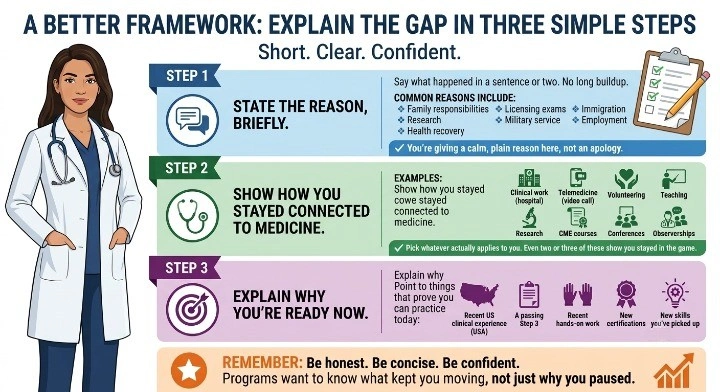
Say what happened in a sentence or two. No long buildup. Common reasons include:
You’re giving a calm, plain reason here, not an apology.
This is the step people skip, and it’s the one that matters most. Even during a gap, little things prove you never fully walked away. For example:
Pick whatever actually applies to you. Even two or three of these show you stayed in the game.
Finish in the present, looking forward, not back. Point to things that prove you can practice today:
Strung together, it sounds like this: “I stepped away to care for a family member. During that stretch I kept active through telemedicine and CME. Since then I’ve finished a US rotation and passed Step 3, so I’m ready to start.”
Short. Honest. Pointed at the future. That’s really all there is to it.
Practice a calm, confident answer with mentors who’ve sat on the other side of the interview table.
Every gap has its own backstory. Here’s how to handle the common ones. Watch the pattern, though. Each one stays open, brief, and focused on being ready.
Say it plainly and keep moving. Caring for a child or a sick relative earns respect. Mention any medical activity you held onto during that time.
Point to the outcome. If those years went into passing your exams, that’s proof of commitment, not a gap to defend.
Visa and paperwork delays happen constantly, and people get it. Keep it factual, skip the frustration, and show what you did while you waited.
This one’s easy to frame as a plus. Bring up your projects, any publications, and whether patients were involved.
Research is the gap that reads as a plus. Build a real project you can point to on ERAS and in interviews.
Just say you had a health matter and it’s resolved. Your medical history isn’t anyone’s business. Make clear you’re fully able to work now.
Be honest that clinical roles were scarce, then pivot fast to what you did instead, whether that was volunteering, courses, or observerships.
Plenty of careers stalled during the pandemic. Everyone understands this. Focus on how you got moving again afterward.
The playbook doesn’t really change: a clear reason, proof you stayed engaged, and evidence you’re ready today.
Not every document needs the full story. Knowing what goes where keeps you from over-explaining.
This is the main spot. List your jobs, research, and activities with accurate dates. A clean, complete timeline here quietly answers most questions before anyone asks them.
Only bring up the gap if it genuinely shaped your path, or if it’s big enough to need context. If it belongs, give it a sentence or two and then move on. Don’t let it swallow your statement.
it short and calm. Run through the three-step framework and stop.
Double-check that your dates match everything else. That consistency is what earns trust.
The rule is simple. Explain it once, clearly, in the right place, and make sure every document tells the same story.
Explaining the gap is only half of it. The smarter move is showing proof you can practice right now. Evidence wins over words every time.
Here’s what rebuilds a program director’s trust:
The more recent, the better. If you’re working to overcome a graduation gap, this is where to put your energy. A stack of current, relevant experience does more than any explanation ever could.
Recent US clinical experience is the strongest signal of current readiness, and the fastest way to earn recent US letters.
This one trips people up, so let’s sort it out. Yes, some programs do set graduation cutoffs, often at five, seven, or ten years. When a program has a hard rule like that, the filter applies no matter how strong the rest of your file is.
The numbers back this up. In the 2026 Match, U.S. citizen IMGs reached a 70% PGY-1 match rate, the highest on record, while non-U.S. citizen IMGs matched at 56.4%. Those gaps in outcome track far more with recent qualifications, USCE, and program fit why USCE decides so many matches than with a single graduation date. Some programs do set year-of-graduation cutoffs, often around three to five years, but many weigh your recent record more heavily than the calendar.
But here’s the fuller picture, for a lot of programs, recent achievements count for more than your graduation year by itself. Programs that look at the whole applicant will weigh what you’ve done lately.
What helps the most:
Picking the right programs is half the battle. There’s no sense paying fees for programs with cutoffs you can’t clear. Stay realistic, because some doors will be shut, but aim at the many that stay open to a prepared, current applicant.
A gap in your timeline isn’t the end of your residency story. Often it’s just one chapter in a longer, more human path.
So don’t hide it, and don’t apologize for the life you actually lived. Use your story to show something better instead: growth, consistency, and readiness. Then back it up with evidence, like recent experience, current certifications, and solid letters.
Hold onto this as you apply. Program directors aren’t expecting a perfect career. They want residents who are prepared, reliable, and ready to pull their weight from day one. Show them that, and the years behind you start to matter a lot less than the doctor standing in front of them today.
At the end of the day, a gap year doesn’t define you as a doctor. What you did with that time, and how ready you are now, tells the real story. Be honest, stay consistent across every document, and let your recent experience do the heavy lifting. Program directors respond to prepared, reliable applicants, not perfect timelines. So, walk into that interview owning your path. The years behind you matter far less than the physician you’ve become.
If this article resonates with you, follow IMG Helping Hands for more valuable insights and join our research modules and contact us for meaningful US clinical experience so that you can fully utilize your gap years.
IMG HELPING HANDS – FOR EXPERIENCED IMGs
Program directors want one thing: evidence you’re ready to practice today. IMG Helping Hands helps experienced IMGs build exactly that, recent US clinical experience for current US letters, meaningful research you can defend, and interview coaching so the gap question lands as confidence, not apology.
Recent USCE. Real research. A rehearsed, honest gap answer. Mentors who’ve matched as IMGs.
The years behind you matter less than the doctor you are today. Show them.
There’s no set number. Some programs draw the line around five to ten years, while others care more about how you spent the time. A long gap filled with clinical work or research often looks better than a short, empty one. Readiness now matters more than the count.
Yes, though it takes more work. You’ll want strong recent evidence, like US clinical experience, a passing Step 3, and good letters. Aim at IMG-friendly programs without strict cutoffs. Plenty of older IMGs have matched by proving they’re clinically ready today.
Only if it truly shaped your path or is large enough to need context. If so, keep it to a sentence or two and then move on. For smaller gaps, your ERAS Experiences section is usually the better place for it.
Say it plainly: you stepped away to care for a family member. This earns respect, so skip the apology. Then point to any medical activity you kept up and the recent steps you’ve taken to show you’re ready to return.
Yes. Passing Step 3 is one of the strongest signals you can send. It shows your clinical knowledge is current and that you mean business about residency. For anyone with a long gap, it can reassure program directors more than almost anything else.
No. Some enforce strict cutoffs, but many don’t. Policies swing widely by specialty and program. That’s exactly why targeted research pays off. Point your applications at IMG-friendly programs that value recent experience over your graduation date.
Yes. Research shows you stayed engaged and kept thinking critically. Projects with patient exposure are especially useful. Publications, presentations, and clinical research all help fill your timeline and prove you never really left the field.
Often, yes. Recent US clinical experience is one of the best ways to show you’re ready now. It proves you can function in a US setting today, which can outweigh worries about how long ago you graduated. Just keep it recent and relevant.
Not by themselves. An unexplained, clinically inactive gap is the real red flag, since it hints at skill decay or something hidden. A structured gap spent on research, USCE, family, or exams reads as neutral to positive. What you did with the time matters more than the gap itself.
Family Medicine, Internal Medicine, and Psychiatry tend to be the most forgiving of well-explained gaps. These fields rely heavily on IMGs and focus on current readiness. For an older IMG with a solid recent record, they’re usually the strongest ground to target.
It can. Some programs set graduation cutoffs, often three to five years, and those filters apply regardless of your strengths. But many programs weigh recent USCE, a passing Step 3, and strong letters more heavily. Targeting programs without hard cutoffs is the smart move.
Articles published by IMG Helping Hands are prepared by our team using information from direct experience, publicly available resources, and educational references. AI tools may be used to assist with drafting, proofreading, and formatting; however, all content undergoes review and approval before publication.
The information provided is intended for educational purposes only. Requirements, policies, and processes may change over time. Readers should consult official sources for the most current information.