Medical school costs about $59,000 a year on average. That’s before rent. Add four years together and most students spend $300,000 to $400,000. Tuition is only part of it. This guide covers what each year really costs, how public and private schools compare, what’s inside a school’s cost of attendance, and how students lower the bill.
Average medical school tuition in the US is around $59,000 a year. That figure includes fees and health insurance. It’s the answer most people want when they ask how much is medical school per year.
Your own medical school cost per year may look nothing like it. In 2025–2026, in-state students at public schools paid a median of about $43,000. Out-of-state students at those same schools paid about $68,000. Private schools charged around $68,000 no matter where you’re from.
Then there’s the difference that catches people off guard. Tuition pays for your classes. Cost of attendance is what a whole year of your life costs, rent and food included. It’s the bigger number. It’s also the one your loans are based on. Once living expenses are added, most students spend $75,000 to $100,000 a year. The city matters a lot here.
This guide covers US medical school. If you’re an IMG, your spend is on USMLE exams, ECFMG, USCE, and ERAS, not tuition. We can help you plan that path.
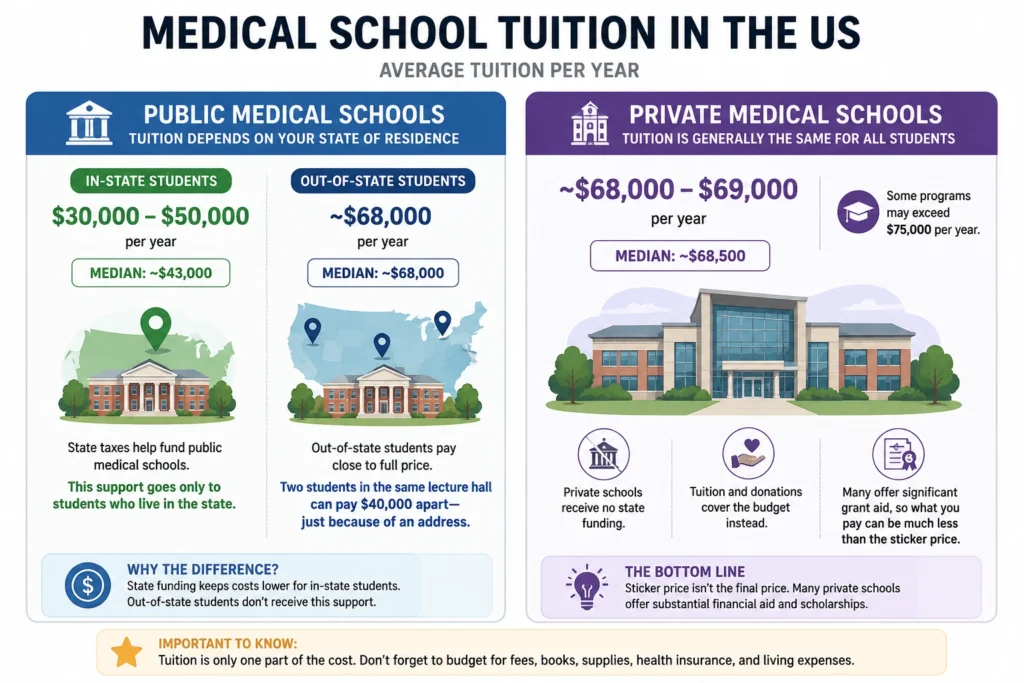
Medical school tuition isn’t one number. It depends on whether the school is public or private. At public schools, it also depends on where you live.
In-state students at public medical schools usually pay $30,000 to $50,000 a year. The median is about $43,000. Apply from another state and the median jumps to roughly $68,000.
Why? State taxes help fund public medical schools. That help only goes to students who live in the state. Everyone else pays close to full price. Two students can sit in the same lecture hall $40,000 apart on med school tuition. The only difference is an address.
Private schools charge about $68,000 to $69,000 a year. Your home state usually doesn’t change that. A few programs go past $75,000.
Private schools get no state funding. Tuition and donors cover the budget instead. But many have big endowments and give real grant aid. So the medical school tuition per year you actually pay can be much lower than the website says.
Tuition is one line on the bill. Every school also publishes a medical school cost of attendance. That’s their estimate of what a student spends in a year. Lenders use it to decide how much you can borrow. Read it closely.
Most of these estimates cover medical school fees, housing, food, and daily costs. They usually skip the one-time stuff. Board exams. Residency applications. Interview travel. Those bills still come. Plan for them yourself.
| Expense | Included? |
| Tuition | ✓ |
| Mandatory fees | ✓ |
| Housing | ✓ |
| Food | ✓ |
| Transportation | ✓ |
| Health insurance | ✓ |
| Books | ✓ |
| Medical equipment | ✓ |
| Licensing exam fees | Often separate |
| Personal expenses | ✓ |
Board exams deserve a mention. In 2026, Step 1 costs $670. Step 2 CK is also $670. Step 3 runs $935. Add question banks and review courses and most students spend a few thousand more, our guide on how to prepare for USMLE Step 1 covers the resources those costs go toward. Very little of that shows up in the published cost of medical school.
Look at tuition alone and four years costs about $165,000 at a public school in-state. At a private school, closer to $265,000.
The real number is higher. AAMC data for the class of 2026 puts the median four-year cost of attendance at $297,745 for public schools and $408,150 for private ones. Those totals include tuition, fees, and four years of living costs.
So how much is medical school for 4 years? Realistically, $300,000 to $410,000. Not the $165,000 to $265,000 on a tuition page. That gap is where students get surprised. It’s also why the total cost of medical school matters more than the average cost of medical school tuition.
| Expense Category | Public (In-State) | Public (Out-of-State) | Private Medical School |
| Annual Tuition & Mandatory Fees | ~$43,000 | ~$68,000 | ~$68,000–70,000 |
| Estimated Living Expenses (Housing, Food, Transportation) | $22,000–30,000 | $22,000–30,000 | $22,000–30,000 |
| Books, Supplies & Equipment | $2,000–4,000 | $2,000–4,000 | $2,000–4,000 |
| Health Insurance | $3,000–6,000 | $3,000–6,000 | $3,000–6,000 |
| Estimated Total Cost of Attendance (Per Year) | $70,000–82,000 | $95,000–108,000 | $96,000–110,000 |
| Estimated Total Cost for 4 Years | $280,000–330,000 | $380,000–430,000 | $385,000–440,000 |
Most students borrow. About 70% of the class of 2025 graduated with education debt. Their average educational debt was $223,130.
That average hides a lot. Some students owe nothing at all. Around a third of borrowers owe more than $250,000. Where you land comes down to a few things. Public or private. In-state or out. Cheap city or expensive one. And whatever you still owe from undergrad.
Scholarships change this more than anything else. Half tuition at an in-state public school can put you under $100,000, and merit awards often track your numbers, so knowing the average MCAT score for medical school helps you gauge where you stand. Full price at a private school in New York can push average medical school debt past $350,000.
The cost of a medical degree is high because medicine is expensive to teach. One professor can lecture 300 business students. Training a doctor doesn’t work that way.
Anatomy labs need cadavers, storage, ventilation, and staff. Clinical rotations need hospital contracts, malpractice coverage, and attending physicians who stop seeing patients to teach you. Simulation centers cost millions. Mannequins, ultrasound machines, paid actors playing patients. All of it has to be maintained.
Faculty ratios are small too. Bedside teaching and direct supervision mean fewer students per teacher. Schools also pay for advising, board prep, and career support. Put it together and the average cost to become a doctor stays well above the doctor degree cost you’d guess from tuition.
Sticker price isn’t final price. There are real ways to lower how much it costs to become a doctor, and the earliest one is scoring well enough to earn merit aid, which starts with the exam itself, see our complete guide to the MCAT. Go after scholarships and grants. Schools give merit and need-based awards.
Go after scholarships and grants: Schools give merit and need-based awards. Outside groups fund medical students too. None of it has to be paid back, so start here.
File the FAFSA every year: Federal aid is still the base for most students. One big change: as of July 1, 2026, Grad PLUS loans are gone for new borrowers. Federal borrowing now runs through Direct Unsubsidized Loans, and those have yearly and lifetime caps. Plan around them early.
Look at service scholarships: The National Health Service Corps and several state programs pay tuition. In return, you practice in an underserved area after training.
Check military programs: The Health Professions Scholarship Program covers full tuition plus a monthly stipend for service years. The Uniformed Services University charges no tuition.
Put in-state public schools high on your list: This single choice can save $100,000 over four years. It’s the easiest way to cut the cost of medical school in the US, though it starts far earlier, with a strong application built on a competitive score, so plan for the MCAT and its long test day well ahead of time.
Keep living costs down: Roommates. Cooking at home. Used books. Boring advice, but this is the only part of the budget you actually control.
Read up on loan repayment programs now: Public Service Loan Forgiveness and state programs erase big balances for doctors who qualify.
Is medical school expensive? Yes. But the return holds up. Physicians and surgeons had a median salary of about $239,200 in 2024. Plenty of specialties earn more.
Timing is the hard part. First-year residents earn a median of roughly $67,000. Interest keeps building the whole time. You carry a six-figure balance on a small salary for three to seven years before income catches up.
There’s opportunity cost too. Friends in other careers start saving years ahead of you. Even so, medicine usually wins over a full career. Job security is hard to beat.
Is med school expensive compared to what you get back? For most people, it’s manageable. Borrow carefully. Pick your school on total price, not just name. Have a repayment plan before you graduate.
A strong application starts years before matriculation. Our complete MCAT guide covers scoring, timing, and what a competitive score looks like.
About $59,000 a year for tuition, fees, and health insurance. Add housing, food, and daily expenses and the yearly cost of attendance usually lands between $75,000 and $100,000. Your school and its city drive most of that difference.
For the class of 2026, the median four-year cost of attendance is $297,745 at public schools and $408,150 at private schools. These totals include living costs, which is why they’re so much higher than tuition figures alone.
Tuition and fees run about $43,000 in-state at a public school, $68,000 out of state, and around $68,000 at private schools. Once you add rent, food, and transportation, a single year usually passes $75,000.
Roughly $59,000 a year on average across the country, including fees and insurance. Public schools charge in-state students much less. Private schools charge nearly everyone the same. A few schools charge no tuition at all.
Medical school alone is $300,000 to $410,000 over four years. Add undergrad, the MCAT, application fees, board exams, and residency interviews. The full path often passes $400,000 before your first attending paycheck.
It depends on the school type and the city. An in-state public school somewhere affordable might stay under $300,000 for four years. A private school in an expensive metro can reach or pass $410,000 once housing is counted.
Yes. It’s one of the priciest graduate degrees in the US. About 70% of graduates leave with education debt averaging $223,130. Scholarships, in-state tuition, and service programs can bring that number down a lot.
Tuition isn’t what medical school costs. Housing, food, insurance, books, equipment, and board exams push four-year totals to about $300,000 at public schools and $408,000 at private ones. None of that is set in stone. Apply for scholarships early. File the FAFSA every year. Look at service and military programs. Pick a school you can afford. And when you build your list, compare the cost of attendance instead of tuition. That’s the number you’ll live with.
AAMC: “You Can Afford Medical School” (students-residents.aamc.org)
AAMC: Medical Student Education: Debt, Costs, and Loan Repayment Fact Card, Class of 2025
IMG Helping Hands guides students and international graduates across the whole journey. Book a free call and we’ll help you map the path and the costs that come with it.
Articles published by IMG Helping Hands are prepared by our team using information from direct experience, publicly available resources, and educational references. AI tools may be used to assist with drafting, proofreading, and formatting; however, all content undergoes review and approval before publication.
The information provided is intended for educational purposes only. Requirements, policies, and processes may change over time. Readers should consult official sources for the most current information.