
Should you select a geographic preference in ERAS? Which regions should you pick? What do you write in the explanation box, and does any of it actually help your application?
These questions come up every year when applicant are filling geographical/geographic preference section in their ERAS application, and they rarely get a clear answer.
Geographic Preference is a section of the MyERAS application that lets you tell residency programs which parts of the United States you would prefer to train in, along with the kind of setting you prefer. For international medical graduates, this section can feel especially confusing. If you have never lived or worked in the US, what preference are you supposed to have?
This guide walks through the most anticipated questions related to this topic.
Geographic Preference is the part of your MyERAS application where you indicate your preference, or lack of preference, for particular areas of the United States. You can select up to three US Census divisions and then explain your choice in a short text box.
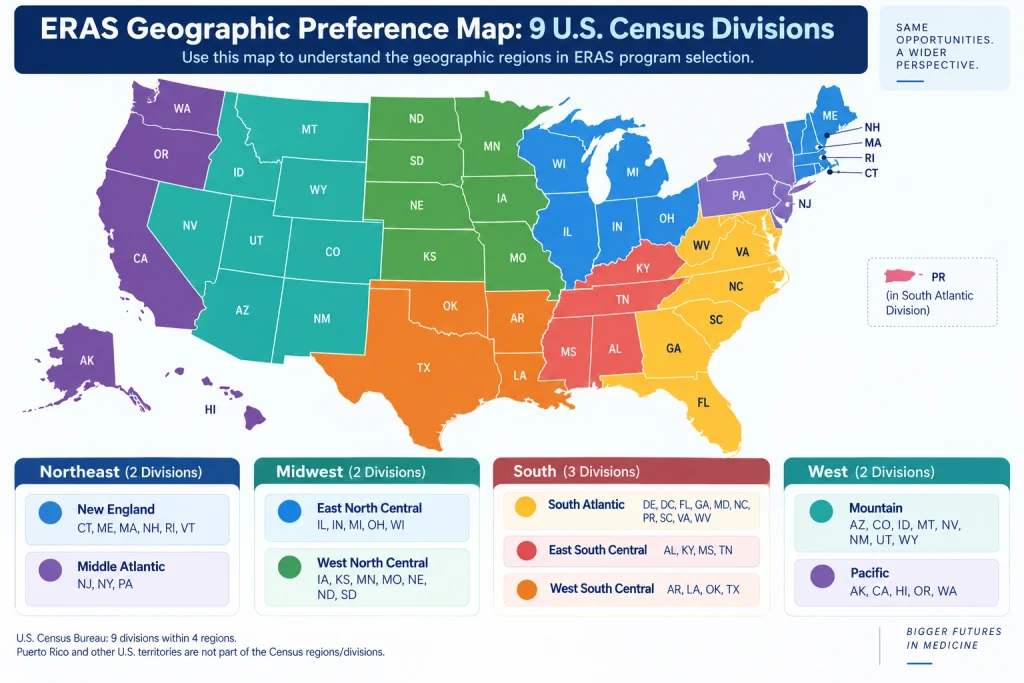
A geographic division is simply a group of states that the US Census Bureau has placed together, such as New England or the Pacific division. ERAS uses these nine divisions rather than individual states or cities.
Geographic Preference sits alongside a second question called Setting Preference, which asks whether you prefer an urban, suburban, or rural training environment. The two are separate answers, and both include a space to explain yourself.
It helps to treat this section as a communication tool instead of a checkbox.
In plain terms: Geographic Preference tells residency programs, “These are the parts of the US where I would prefer to complete my residency.”
ERAS groups all US states and territories into nine Census divisions. When you select your preferences, you are choosing from this list.
| ERAS Geographic Division | States and Territories |
| New England | Connecticut, Maine, Massachusetts, New Hampshire, Rhode Island, Vermont |
| Middle Atlantic | New Jersey, New York, Pennsylvania |
| East North Central | Illinois, Indiana, Michigan, Ohio, Wisconsin |
| West North Central | Iowa, Kansas, Minnesota, Missouri, Nebraska, North Dakota, South Dakota |
| South Atlantic | Delaware, Washington DC, Florida, Georgia, Maryland, North Carolina, Puerto Rico, South Carolina, Virginia, West Virginia |
| East South Central | Alabama, Kentucky, Mississippi, Tennessee |
| West South Central | Arkansas, Louisiana, Oklahoma, Texas |
| Mountain | Arizona, Colorado, Idaho, Montana, Nevada, New Mexico, Utah, Wyoming |
| Pacific | Alaska, California, Hawaii, Oregon, Washington |
A few things worth noticing before you choose.
Puerto Rico falls under South Atlantic, which matters for applicants considering programs there. Washington DC is also grouped with South Atlantic, not with Middle Atlantic, even though it sits close to Maryland and Virginia.
The divisions are also uneven in size. Middle Atlantic covers three states but contains a very large share of residency positions, while Mountain covers eight states with far fewer programs. Selecting a division is not the same as selecting a proportional slice of the Match.
Applicants often misunderstand who actually sees this information. There are three possible outcomes.
If you select one or more divisions Only the programs you apply to that are located inside those divisions will see your response and explanation. Programs outside your selected divisions receive nothing about your geographic preference. So if you select Pacific, a program in New England will not know you chose Pacific, and it will not know you answered the question at all.
If you select “I do not have a division preference” Every program you apply to will see that response and your explanation.
If you skip the question No geographic preference information goes to any program.
Two more points matter for 2027. Programs are told to use these answers as one piece of context during application review and interview selection, since applicants often change their minds during the season. And for the 2027 ERAS season, Otolaryngology, Orthopedic Surgery, and Plastic Surgery-Integrated have opted out of receiving geographic preference answers, along with setting preference answers.
2027 ERAS season updates
These two features get mixed up constantly, and they do different jobs.
| Geographic Preference | Program Signal |
| Points to a preferred part of the country | Points to one specific program |
| Based on Census divisions | Based on individual residency programs |
| Up to three divisions | Number varies by specialty |
| Communicates where you want to live and train | Communicates interest in that program |
A program signal is your chance to show genuine interest in a particular residency program, and specialties set their own limits on how many signals you get. If you’re still deciding where to spend them, our guide on how IMGs should use program signals in 2027 covers the strategy. The short version: geographic preference answers “Where would you like to train?” while your program signal answers “Which programs are you especially interested in?”
The short version: your geographic preference answers “Where would you like to train?” while your program signal answers “Which programs are you especially interested in?”
You can use both, and they should point in the same direction. Signaling six programs in Texas while listing New England and Pacific as your preferred divisions sends a confusing message.
Book a free call with mentors who matched as IMGs. We’ll help you align your regions, signals, and program list so they point the same direction.
There is no ranking of “good” and “bad” divisions. Work through these five factors instead.
1. Family or personal connections: Do you have family, a spouse, close friends, or any support system in the region? This is the most credible reason you can give, and programs take it seriously because it predicts whether you will stay.
2: Previous US experience: Did you complete an observership, externship, clinical rotation, or research experience there? For IMGs, this is often the strongest available tie, and our guide on hands-on US clinical experience covers how to build the kind that anchors a credible regional choice. It also connects naturally to your letters of recommendation.
3. Career interests: Are the programs that match your goals concentrated in a particular area? If you want a nephrology-heavy internal medicine program or a strong safety-net hospital experience, that can shape where you look.
4. Lifestyle and practical factors: Think about cost of living, public transportation, climate, urban versus rural life, and how far you would be from people you rely on. AAMC’s own survey of applicants found the common reasons given were proximity to family and friends, desired program location, prior regional ties, and lifestyle.
5. Your actual program list: This one is easy to skip and important. Do not select a division because you heard it is “IMG friendly.” Ask instead: does the list of programs I am applying to actually sit in these divisions? If not, change one or the other.
Your explanation box has a 300-character limit, so every example below is written to fit. Aim for two or three sentences.
Example 1: Applicant with family in Texas Preference: West South Central
“I have close family in Texas and spend time there regularly, so I already have a support system in the region. I would be glad to train here and stay near them through residency and beyond.”
This works because it names a specific, checkable tie and explains what it gives the applicant.
Example 2: IMG with previous clinical experience in New York Preference: Middle Atlantic
“I completed clinical rotations in New York and built professional relationships there, including with two of my letter writers. I understand how care is delivered in that setting and would value continuing my training in the region.”
This is the strongest option for most IMGs. It ties your preference to documented experience elsewhere in your application.
Example 3: Applicant with reasons for more than one region Preference: East North Central, Middle Atlantic, South Atlantic
“My observership was in Ohio and my sister lives in Maryland. I am also drawn to Middle Atlantic programs with large county hospital patient populations, which matches the care I provided during my internship.”
Three divisions is a ceiling, not a target. Only use all three when you can defend each one in a single sentence.
Example 4: Applicant with no geographic ties Preference: I do not have a division preference
“I do not have a strong regional preference and am open to training anywhere in the US. My priority is a program with a large inpatient volume, strong fellowship support, and experience training international graduates.”
This is an honest, common answer for IMGs applying from abroad, and it reaches every program you apply to. Notice that it still says something useful about what the applicant wants.
Use a simple structure: Connection + Reason + Fit.
Name the tie, say why it matters, and link it to residency.
“I have family in [region], which gives me an established support system. The programs I am most interested in are concentrated there, and I want to train in a place where I can build long-term roots.”
Keep the tone plain. This is not a second personal statement, and with 300 characters you do not have room for one anyway.
Avoid:
The question you are answering is “Why this region?” not “Why should this program rank me?” Programs have your whole application for that.
Write your explanation in a document first, check the character count, then paste it in.
“I do not have a division preference” is a legitimate answer, not a weak one. If you select it, your response and explanation go to every program you apply to.
It is also common among IMGs. In one AAMC analysis of internal medicine applications, more than a quarter of IMG applications indicated no geographic preference, compared with roughly one in ten applications from US MD students.
You do not need to invent a connection to the US Midwest because you think it sounds better. If you are genuinely open, saying so honestly reaches more programs than a preference you cannot explain.
However, it is generally preferred to use this as an opportunity to show programs that you have genuine interest. This can help you getting interviews
For IMGs, where you signal interest connects to visa fit, USCE, and which programs actually take you. We’ll help you make that answer work in your favor.
None of these will sink an application by itself. Together, they waste a section that takes fifteen minutes to do well.
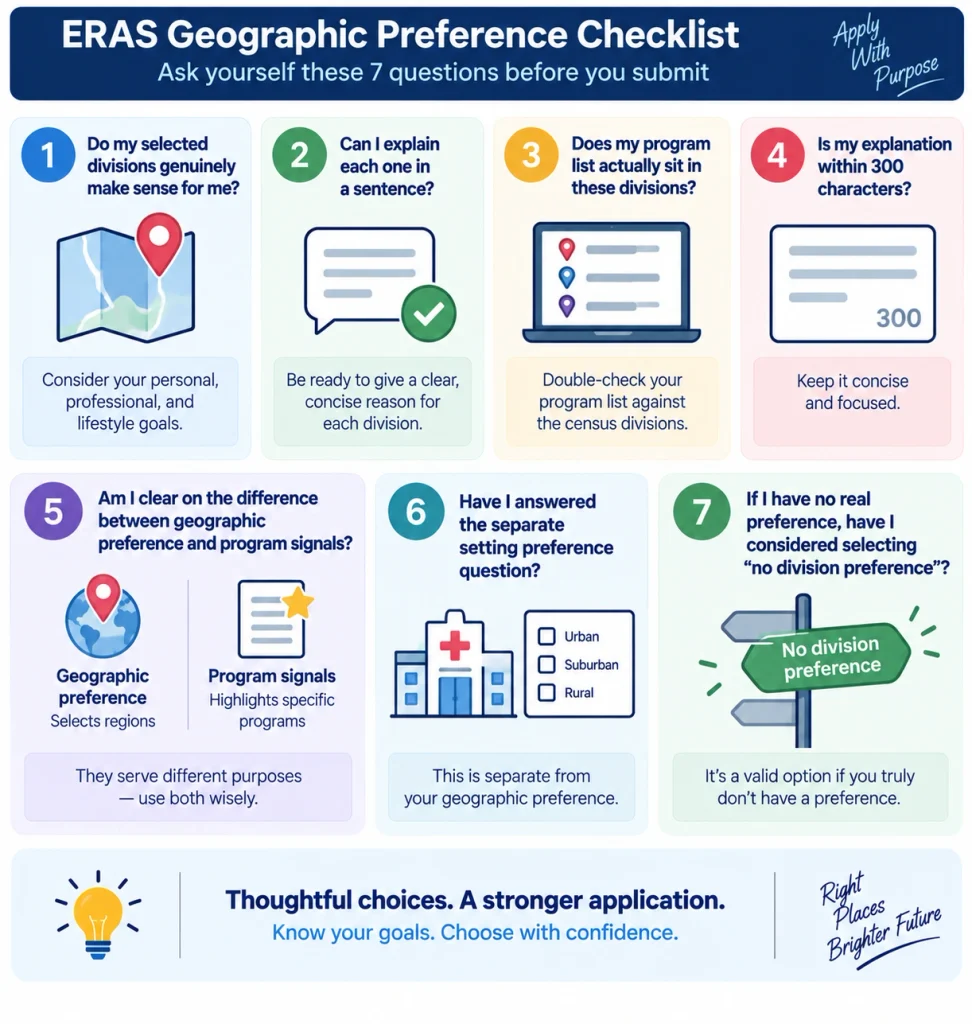
Before you submit, run through these:
Geographic Preference is not about finding the best region. It is about giving programs honest context about where you would like to train and why.
Choose divisions based on real connections, career goals, and practical life factors. Make sure your explanation supports what you selected, and make sure your program list does too. Then move on the rest of your application carries far more weight than this one section.
Geographic preference is one small answer in a much bigger strategy. It only works when it lines up with your signals, your program list, and your profile. That’s what we build with you. Here’s how:
It is a MyERAS section where you indicate your preference, or lack of preference, for up to three US Census divisions and explain that choice in 300 characters or fewer.
Up to three divisions. You can also select “I do not have a division preference,” or skip the question entirely.
New England, Middle Atlantic, East North Central, West North Central, South Atlantic, East South Central, West South Central, Mountain, and Pacific.
Yes, if you have a real tie such as family, prior US clinical experience, or a program list concentrated in one area. If not, “no division preference” is honest and reaches every program you apply to.
Name your connection, explain why it matters, and link it to residency training. Two or three plain sentences inside the 300-character limit.
Programs are instructed to use it as one piece of information during application review and interview selection. It is context, not a deciding factor.
No. Geographic preference points to a region. A program signal points to one specific program.
Yes. Select “I do not have a division preference,” and all programs you apply to will see that response.
“I completed clinical rotations in New York and built professional relationships there, including with two of my letter writers. I would value continuing my training in the region.”
It helps programs understand where you want to be, which can reduce guesswork based on your medical school’s location. It will not compensate for the rest of your application.
Articles published by IMG Helping Hands are prepared by our team using information from direct experience, publicly available resources, and educational references. AI tools may be used to assist with drafting, proofreading, and formatting; however, all content undergoes review and approval before publication.
The information provided is intended for educational purposes only. Requirements, policies, and processes may change over time. Readers should consult official sources for the most current information.