
A high-yield, exam-first Step 1 masterclass, the enzyme, the odor, the urine, the lens, and the mnemonic that ends the confusion.
KEY TAKEAWAYS (MEMORIZE THESE ONE LINERS)
Four names, four smells, four eye or urine findings, and somehow they always blur together at the worst moment. PKU, alkaptonuria, homocystinuria, and MSUD are a favourite of the exam precisely because each one hangs on a single sensory clue, and a tired brain swaps them under pressure.
The amino acid disorders tested on USMLE Step 1 are efficient question fodder: one vignette can probe the enzyme, the accumulated metabolite, the buzzword, the inheritance, and the treatment all at once. Learn to read the clue and you collect the whole question. This guide builds that reflex, clue in, disease out.
| WHY IMGS GET THIS WRONG They memorize enzyme names without tying each to its signature clue (odor, urine, lens), so the clues become interchangeable. They confuse homocystinuria with Marfan because both are tall and long-limbed, forgetting the lens goes down in homocystinuria and up in Marfan.They forget tyrosine becomes essential in PKU, and that maternal PKU harms the fetus even when the mother is stable. |
Every disorder in this guide is the same story. An enzyme on an amino acid pathway is missing, so the substrate before the block piles up while the product after it runs short. The accumulated substrate is what produces the buzzword, the odor, the urine change, the toxic injury, and it’s usually the whole answer to the question.
This is also why newborn screening matters: catching PKU and MSUD before the toxic substrate accumulates lets early dietary treatment prevent the damage entirely. Keep the picture below in mind for every disease that follows.
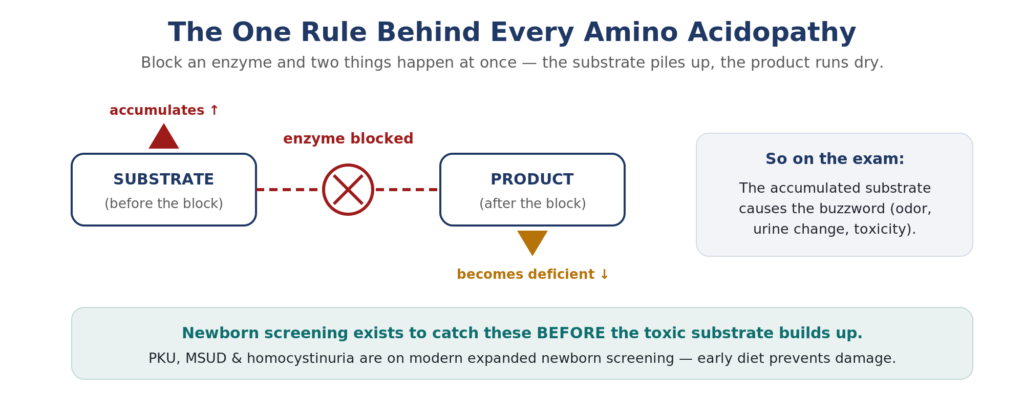
Figure 1. The shared mechanism: block the enzyme and the substrate accumulates while the product falls.
Two of our four disorders live on a single line, the breakdown of phenylalanine. The figure below traces that pathway and marks exactly where PKU and alkaptonuria block it, and what backs up behind each block. Further down the same chain, loss of fumarylacetoacetate hydrolase causes tyrosinemia type I, worth recognizing even though PKU and alkaptonuria are the higher-yield blocks.
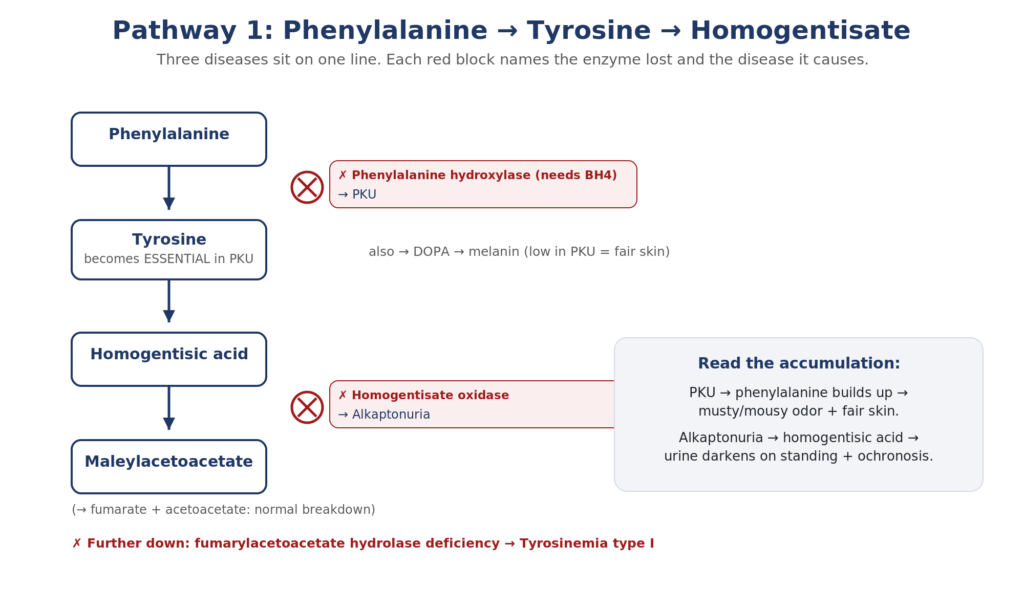
Figure 2. PKU and alkaptonuria are two blocks on the same phenylalanine-to-homogentisate pathway.
Picture a fair skinned infant with eczema, developmental delay, and a musty or mousy odor to the urine and sweat. That’s PKU. Phenylalanine hydroxylase is deficient (or its cofactor tetrahydrobiopterin, BH4, is missing in the ‘malignant’ form), so phenylalanine can’t be converted to tyrosine. Phenylalanine floods the body and spills over into phenylketones, while tyrosine becomes an essential amino acid, and because tyrosine feeds melanin, patients are pale.
Treatment is a lifelong low phenylalanine diet, avoidance of aspartame, and tyrosine supplementation: BH4-responsive cases get sapropterin. Don’t forget maternal PKU syndrome: a mother with poorly controlled phenylalanine exposes the fetus to a teratogen, causing microcephaly, congenital heart defects, and intellectual disability even though the baby doesn’t have PKU itself. It’s autosomal recessive and caught on newborn screening.
| WHY THE BUZZWORD HAPPENS The musty/mousy odor comes from phenylacetate and related phenylketones excreted when phenylalanine backs up. Fair skin and hair result because tyrosine, the precursor of melanin, is now in short supply behind the block. |
| MNEMONICPKU = Phenylalanine piles up, tyrosine’s now a King(U) you must supply. Musty mouse smell, pale skin, skip the aspartame, and watch the pregnant mom (maternal PKU). |
Now a very different story: a patient whose urine turns black on standing, with dark-pigmented cartilage and arthralgias in later life. That’s alkaptonuria. Homogentisate oxidase is deficient, so homogentisic acid accumulates in the tyrosine degradation pathway. In the diaper or the toilet, homogentisic acid oxidizes on air exposure and the urine darkens: deposited in connective tissue it produces the blue-black pigment of ochronosis.
Compared with the others, alkaptonuria is relatively benign, the arthritis is the main burden, but its buzzwords are pure exam gold. It is autosomal recessive.
| WHY THE BUZZWORD HAPPENS Urine darkens on standing because accumulated homogentisic acid oxidizes and polymerizes to a dark pigment once exposed to air. Ochronosis is that same pigment deposited in cartilage and connective tissue, turning it blue-black and driving arthritis. |
| MNEMONICalkAPTonuria → Acid (homogentisic) that turns urine blAcK. Old, Achy, black cartilage = Ochronosis. Missing enzyme = homogentisate Oxidase. |
The next disorder sits one pathway over, where methionine is processed through homocysteine. The figure shows the enzyme block and the three vitamin cofactors, B6, B12, and folate, that keep homocysteine moving.
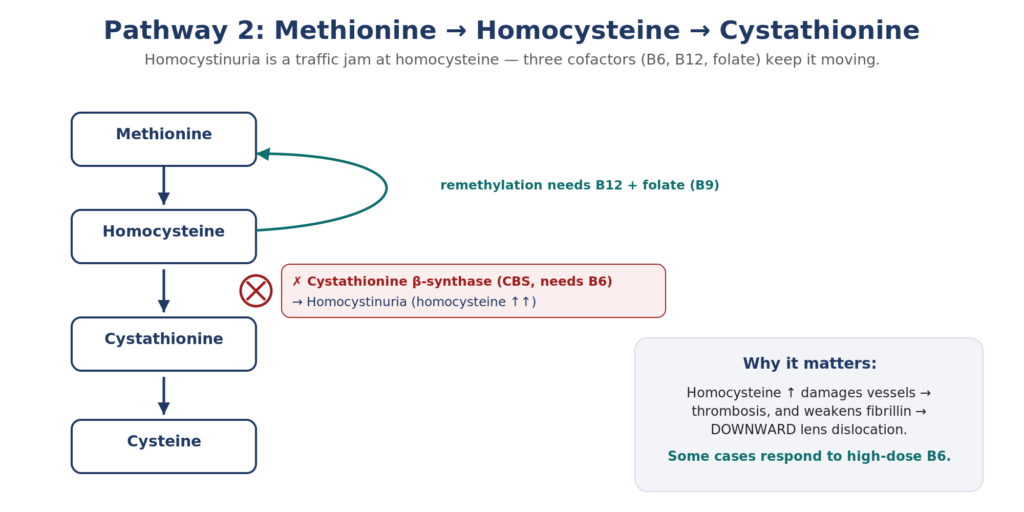
Figure 3. Homocystinuria is a block at homocysteine: B6, B12, and folate are the cofactors that clear it.
Think of a tall, long limbed teenager with intellectual disability, a lens that has dislocated downward (ectopia lentis), and a history of thrombosis, perhaps a stroke or DVT at a shockingly young age. That’s homocystinuria, most commonly from cystathionine β-synthase deficiency (cystathionine synthase, CBS). Homocysteine and methionine accumulate: homocysteine is toxic to vascular endothelium (hence the clots) and disrupts fibrillin cross linking (hence the marfanoid habitus and lens dislocation).
Treatment depends on the subtype: the B6 (pyridoxine)-responsive form improves on high dose vitamin B6, and management otherwise restricts methionine while supplementing cysteine, folate, and B12 (and betaine). It is autosomal recessive.
| WHY THE BUZZWORD HAPPENS Downward (inferonasal) lens dislocation occurs because excess homocysteine disrupts the fibrillin and connective tissue scaffolding that suspends the lens. Thrombosis results from homocysteine’s direct toxicity to vascular endothelium, promoting clot formation and premature atherosclerosis. |
| MNEMONICHOMOcystinuria: HOMOcysteine is HIGH, the lens drops DOWN toward home, and clots form. Try B6 first (it’s the CBS cofactor). |
Because both conditions produce a tall, long limbed marfanoid habitus, the NBME leans on four discriminators, above all the direction of lens dislocation. The table view below locks in every difference.
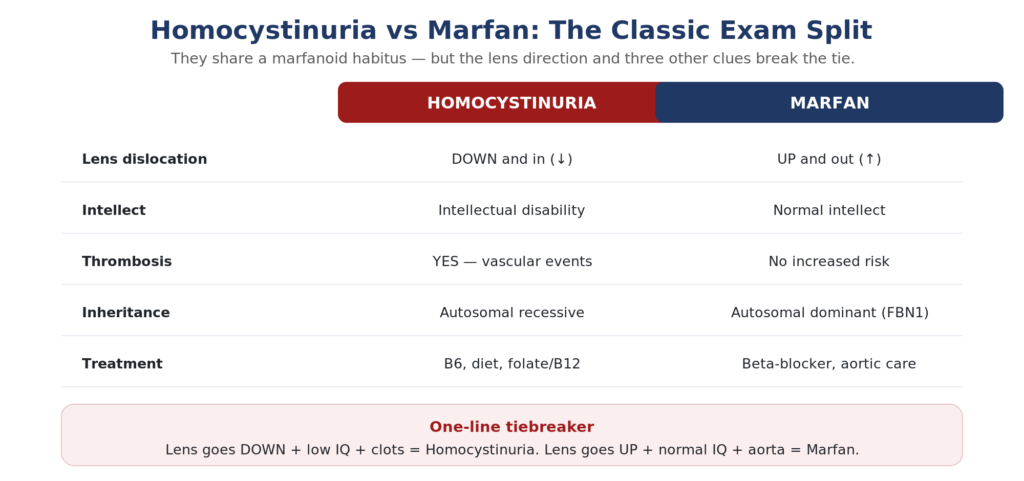
Figure 4. Lens direction, intellect, thrombosis, and inheritance separate homocystinuria from Marfan syndrome.
The last of the four is a newborn emergency. A baby feeds poorly, vomits, becomes lethargic and hypertonic, and the urine and cerumen smell of maple syrup or burnt sugar. That’s MSUD. Branched-chain α-ketoacid dehydrogenase is deficient, so the branched chain amino acids, isoleucine, leucine, and valine, and their α-ketoacids accumulate and poison the CNS. Without treatment it causes severe intellectual disability and death.
Management restricts the branched chain amino acids in the diet (some cases respond partly to thiamine), and MSUD is picked up on newborn screening. It is autosomal recessive.
| MNEMONICMSUD → ‘I Love Vermont maple syrup’ = Isoleucine, Leucine, Valine. Blocked branched chain α-ketoacid dehydrogenase = sweet smelling, sick newborn. |
Here is the whole set on one screen. Each disorder is lined up across the six features the exam actually tests, the deficient enzyme, the cofactor where relevant, what accumulates, the signature clue, inheritance, and treatment. If you memorize one table, make it this one.
| Disorder | Enzyme (cofactor) | Accumulates | Signature clue | Inherit. | Treatment |
|---|---|---|---|---|---|
| PKU | Phenylalanine hydroxylase (BH4) | Phenylalanine | Musty odor, fair skin | AR | Low-Phe diet, avoid aspartame |
| Alkaptonuria | Homogentisate oxidase | Homogentisic acid | Dark urine on standing, ochronosis | AR | Supportive: nitisinone |
| Homocystinuria | Cystathionine β-synthase (B6) | Homocysteine | Downward lens, thrombosis, low IQ | AR | B6, diet, folate/B12 |
| MSUD | Branched chain α-ketoacid dehydrogenase | Ile / Leu / Val | Maple syrup urine odor | AR | Restrict BCAAs (± thiamine) |
| MASTER MNEMONIC: ODOR / URINE / EYE KEY MUSTY smell = PKU · MAPLE syrup = MSUD · DARK urine on standing = Alkaptonuria · DOWNWARD lens + clots = Homocystinuria. Lens direction: DOWN = homocystinuria, UP = Marfan. Cofactor to try in homocystinuria: vitamin B6. All four are autosomal recessive. PKU, MSUD, and homocystinuria are picked up on modern expanded newborn screening panels. |
That’s the UIT method. Learn Step 1 biochemistry and genetics as pattern recognition, where IMGs lose the most avoidable points.
Exam stems hand you a smell, a urine colour, or an eye finding and expect an instant match. The map below pairs each signature clue with its disorder, the exact leap your eye should make while reading.
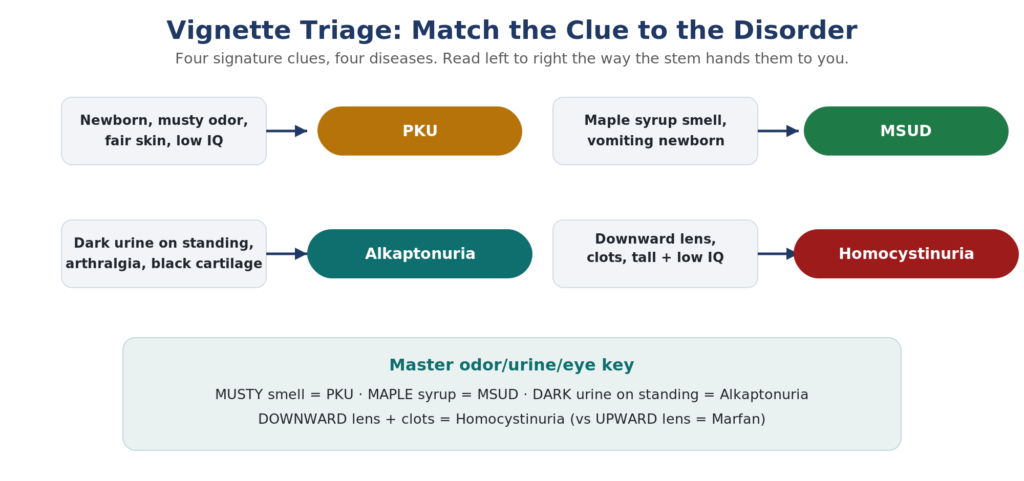
Figure 5. Four signature clues routed to four disorders, with the master odor/urine/eye key.
Questions give you the buzzword first, so train the reverse direction. Read the left column as the phrase you’d spot in a vignette and the right column as the answer it points to.
| You see this buzzword… | → Name this disorder |
|---|---|
| Musty / mousy body odor + fair skin | PKU |
| Newborn with maple syrup / burnt-sugar urine | MSUD |
| Urine turns black on standing | Alkaptonuria |
| Blue-black cartilage + arthritis (ochronosis) | Alkaptonuria |
| Downward lens dislocation + thrombosis | Homocystinuria |
| Marfanoid habitus + low IQ + clots | Homocystinuria |
| Upward lens dislocation, normal IQ | Marfan syndrome |
| Tyrosine becomes an essential amino acid | PKU |
| Improves on high dose vitamin B6 | Homocystinuria (B6-responsive) |
| Microcephaly + heart defects in baby of a well mother | Maternal PKU syndrome |
These are the common NBME traps and how to spot them, the specific swaps the exam reuses. Learn to see them coming.
These are original, NBME style single best answers matched to real exam phrasing and difficulty. Commit to an answer before reading the explanation.
A 4 month old, previously well, has developmental delay, eczema, unusually fair skin and hair, and a musty odor to the urine. Newborn screening was not performed. Which enzyme is most likely deficient?
(A) Homogentisate oxidase
(B) Phenylalanine hydroxylase
(C) Cystathionine β-synthase
(D) Branched-chain α-ketoacid dehydrogenase
(E) Tyrosinase
| ANSWER: B PHENYLALANINE HYDROXYLASE Fair skin/hair + eczema + musty odor + developmental delay = PKU (phenylalanine hydroxylase deficiency), phenylalanine accumulates and tyrosine becomes essential, lowering melanin. (A) Alkaptonuria = dark urine on standing. (C) Homocystinuria = downward lens + clots. (D) MSUD = maple syrup odor. (E) Tyrosinase deficiency = albinism, not this picture. |
A 45-year old man notes that his urine turns black if left in the toilet, and he has chronic low back and joint pain. Exam shows bluish-black discoloration of the ear cartilage. Which metabolite accumulates?
(A) Phenylalanine
(B) Homocysteine
(C) Homogentisic acid
(D) Leucine
(E) Branched-chain α-ketoacids
| ANSWER: C HOMOGENTISIC ACID Urine that darkens on standing + ochronosis (blue-black cartilage) + arthritis = alkaptonuria (homogentisate oxidase deficiency → homogentisic acid accumulation). (A) PKU = musty odor (B) homocystinuria = lens/clots (D)/(E) MSUD = maple syrup odor. |
A 12-year old boy is tall with long fingers and has dislocated ocular lenses. Slit-lamp shows the lenses displaced downward. He has intellectual disability and suffered a deep vein thrombosis last year. Which is the most appropriate initial treatment to trial?
(A) Beta-blocker
(B) High dose vitamin B6 (pyridoxine)
(C) Low phenylalanine diet
(D) Thiamine
(E) Vitamin C
| ANSWER: B HIGH DOSE VITAMIN B6 Downward lens + intellectual disability + thrombosis = homocystinuria (CBS deficiency). Many cases are B6-responsive, so high dose pyridoxine is the initial trial. (A) treats Marfan’s aortic risk (C) treats PKU (D) is used in some (thiamine-responsive) MSUD (E) has only limited, unproven benefit in alkaptonuria (nitisinone is the disease-directed option). |
A 6-day old infant has poor feeding, vomiting, lethargy, and increased tone. The urine and cerumen have a sweet, maple syrup odor. Which amino acids accumulate?
(A) Phenylalanine only
(B) Homocysteine and methionine
(C) Isoleucine, leucine, and valine
(D) Tyrosine and homogentisic acid
(E) Glycine
| ANSWER: C ISOLEUCINE, LEUCINE, AND VALINE A sick neonate with maple syrup smelling urine = MSUD (branched-chain α-ketoacid dehydrogenase deficiency), the branched-chain amino acids and their α-ketoacids accumulate. Remember ‘I Love Vermont’ = Isoleucine, Leucine, Valine. Other options match different disorders. |
A woman with PKU who stopped her dietary restriction as an adult gives birth. The infant, who does not have PKU, has microcephaly, a ventricular septal defect, and growth restriction. What is the mechanism of the infant’s findings?
(A) Inherited phenylalanine hydroxylase deficiency
(B) Teratogenic effect of high maternal phenylalanine
(C) Folate deficiency in the infant
(D) Homocysteine induced thrombosis
(E) Branched chain amino acid toxicity
| ANSWER: B TERATOGENIC EFFECT OF HIGH MATERNAL PHENYLALANINE This is maternal PKU syndrome: elevated maternal phenylalanine crosses the placenta and acts as a teratogen, causing microcephaly, congenital heart disease, and growth restriction, even though the infant does not have PKU. (A) would require the infant to be affected, the others are unrelated mechanisms. |
Two tall adolescents both have dislocated ocular lenses. Patient 1’s lens is displaced upward and he has normal intelligence and a dilated aortic root. Patient 2’s lens is displaced downward and she has intellectual disability. Which is correct?
(A) Both have Marfan syndrome
(B) Patient 1 has Marfan: Patient 2 has homocystinuria
(C) Patient 1 has homocystinuria: Patient 2 has Marfan
(D) Both have homocystinuria
(E) Patient 1 has PKU: Patient 2 has MSUD
| ANSWER: B PATIENT 1 MARFAN: PATIENT 2 HOMOCYSTINURIA Upward lens + normal IQ + aortic root dilation = Marfan (autosomal dominant, FBN1). Downward lens + intellectual disability = homocystinuria (autosomal recessive, CBS deficiency, with thrombosis risk). The lens direction plus intellect settles it, (A), (C), (D), (E) contradict those findings. |
A newborn screening panel flags an infant for a disorder of phenylalanine metabolism. The child is started on a specialized diet. Which additional dietary instruction is most important?
(A) Increase branched-chain amino acids
(B) Avoid aspartame-containing products
(C) Restrict vitamin B6
(D) Add methionine supplements
(E) Eliminate vitamin C
| ANSWER: B AVOID ASPARTAME-CONTAINING PRODUCTS In PKU, aspartame is a phenylalanine source and must be avoided, the diet is low phenylalanine with tyrosine supplementation. (A) relates to MSUD, (C)/(D) relates to homocystinuria, (E) is not indicated. |
A researcher studies a benign autosomal recessive condition in which a defect in tyrosine degradation leads to accumulation of a metabolite that oxidizes to a dark pigment, depositing in connective tissue. Which enzyme is deficient?
(A) Phenylalanine hydroxylase
(B) Homogentisate oxidase
(C) Cystathionine β-synthase
(D) Tyrosine hydroxylase
(E) Branched-chain α-ketoacid dehydrogenase
| ANSWER: B HOMOGENTISATE OXIDASE A tyrosine degradation defect producing a pigment that darkens and deposits in tissue (ochronosis) is alkaptonuria, homogentisate oxidase deficiency. The other enzymes belong to PKU, homocystinuria, catecholamine synthesis, and MSUD respectively. |
A child with poorly controlled disease has markedly elevated plasma phenylalanine despite adequate phenylalanine hydroxylase activity on testing. Which cofactor deficiency should be suspected?
(A) Vitamin B12
(B) Tetrahydrobiopterin (BH4)
(C) Vitamin B6
(D) Biotin
(E) Thiamine
| ANSWER: B TETRAHYDROBIOPTERIN (BH4) When phenylalanine hydroxylase activity is intact but phenylalanine is still high, suspect deficiency of its cofactor tetrahydrobiopterin (BH4), the ‘malignant’ form of PKU, treated with sapropterin and neurotransmitter precursors. The other vitamins are cofactors for unrelated reactions (homocysteine remethylation, CBS, carboxylases, MSUD). |
A 15-year old with a marfanoid habitus is found to have elevated plasma homocysteine and methionine with low cysteine. Beyond a B6 trial, which dietary change is most appropriate?
(A) Increase phenylalanine
(B) Restrict methionine and supplement cysteine
(C) Restrict branched-chain amino acids
(D) High protein, unrestricted diet
(E) Restrict tyrosine
| ANSWER: B RESTRICT METHIONINE AND SUPPLEMENT CYSTEINE In homocystinuria, methionine is upstream of the block and accumulates, while cysteine is downstream and becomes deficient, so restrict methionine and supplement cysteine (plus folate/B12 and betaine), alongside a B6 trial. (C) is MSUD management, the others don’t address the CBS block. |
Get an honest read on your Step 1 prep from IMG mentors who’ve matched, and a plan built around your weak areas.
Screenshot this. Every amino acidopathy compressed to the enzyme, the accumulated metabolite, and the one clue that nails it.
| Disorder | Enzyme / cofactor | Accumulates | Nail-it buzzword |
|---|---|---|---|
| PKU | Phenylalanine hydroxylase / BH4 | Phenylalanine | Musty odor + fair skin, tyrosine essential |
| Alkaptonuria | Homogentisate oxidase | Homogentisic acid | Urine black on standing + ochronosis |
| Homocystinuria | Cystathionine β-synthase / B6 | Homocysteine | DOWNWARD lens + clots + low IQ |
| MSUD | Branched chain α-ketoacid dehydrogenase | Ile / Leu / Val | Maple syrup urine (sick newborn) |
| FASTEST RECALL TRIGGERSMUSTY = PKU · MAPLE = MSUD · DARK-on-standing = Alkaptonuria · DOWN lens + clots = Homocystinuria.Lens: DOWN = homocystinuria, UP = Marfan. Cofactor to trial in homocystinuria = B6. All autosomal recessive. PKU, MSUD & homocystinuria are on modern expanded newborn screening, tyrosine becomes essential in PKU. |
| TAKE THIS FURTHER WITH UIT If amino acid disorders finally clicked, imagine the whole of Step 1 taught this way. The IMG Helping Hands UIT (USMLE Impact Theory) course builds every high-yield topic around the same enzyme → clue → trap → mnemonic engine you just used, so you recognize the answer before you finish the stem. |
The lens direction. Homocystinuria dislocates the lens downward and adds intellectual disability and thrombosis, Marfan dislocates it upward with normal intellect and aortic root dilation.
Phenylalanine hydroxylase normally converts phenylalanine to tyrosine. When the enzyme is deficient, the body can no longer make tyrosine, so it must come from the diet, it becomes an essential amino acid.
Homogentisic acid accumulates and oxidizes on exposure to air, polymerizing into a dark pigment. The same pigment deposits in cartilage, causing ochronosis.
PKU, MSUD, and homocystinuria are all detected on modern expanded US newborn screening panels, allowing early dietary treatment that prevents neurological damage. Classic teaching emphasizes PKU and MSUD, but current panels are broader.
Branched chain α-ketoacid dehydrogenase deficiency lets the branched chain amino acids (isoleucine, leucine, valine) accumulate, producing the characteristic sweet, maple-syrup smell.
Many cases are B6 (pyridoxine)-responsive because B6 is the cofactor for cystathionine β-synthase. Management also includes methionine restriction, cysteine, folate, and B12.
See the highest-yield Step 1 systems mapped the same clue-first way, free, and built for IMGs.
Corroborate high-yield facts against your latest First Aid edition and these authoritative primary sources:
Also: First Aid for the USMLE Step 1 (Biochemistry: amino acid metabolism & metabolic disorders), Lippincott Illustrated Reviews: Biochemistry, NBME Step 1 content outline (current blueprint).
| WHERE UIT FITS Reading one decisive clue and committing to the answer is the exact skill the IMG Helping Hands UIT (USMLE Impact Theory) course drills across all of Step 1, from metabolism to pharmacology to pathology. |
IMG HELPING HANDS – UIT USMLE STEP 1 PROGRAM
Enzyme block, substrate up, product down. One sentence explained the mousy odor, the black urine, the downward lens, and the maple syrup smell. That’s the UIT method, and it runs through every high-yield system on Step 1, live, mapped to First Aid, and built specifically for IMGs.
Clue-first teaching. FA-mapped structure. Live mentorship from doctors who’ve matched as IMGs.
Learn the rule once. Read the clue every time.
Articles published by IMG Helping Hands are prepared by our team using information from direct experience, publicly available resources, and educational references. AI tools may be used to assist with drafting, proofreading, and formatting; however, all content undergoes review and approval before publication.
The information provided is intended for educational purposes only. Requirements, policies, and processes may change over time. Readers should consult official sources for the most current information.