
Yes. A low Step 2 CK score does not shut the door on U.S. residency. But your strategy has to change.
Here is the part most articles skip. No single score guarantees a match, and no single score blocks one. A score can be low for one specialty and perfectly workable for another. Specialty choice, IMG status, visa needs, U.S. clinical experience, number of attempts, year of graduation, letters, research, signals, and each program’s own screening filters all feed into the same decision. A 225 reads very differently in Family Medicine than it does in a highly competitive specialty.
The goal is not to pretend the score doesn’t count. The goal is to build an application that answers the weaknesses sitting around it.NRMP says this plainly too: Charting Outcomes was never designed to predict what will happen to any one applicant.
Applicants ask this constantly, and the honest answer is that “low” is a relative term. Still, most advisors work with rough bands when they plan a strategy. Here is a practical version:
| Step 2 CK range | Practical interpretation |
| 260+ | Very strong |
| 250–259 | Strong |
| 240–249 | Competitive in many specialties |
| 230–239 | Usable, depending on the specialty |
| 220–229 | Lower range; strategy starts to matter a lot |
| 210–219 | Significant limitation |
| Below 210 | Major application challenge |
One thing needs to be said clearly. These are planning bands, not official NRMP cutoffs. NRMP does not publish a line that separates “acceptable” from “unacceptable.” Nobody does.
What the data actually show is a spread. Matched IMGs sit across a wide range of scores. Matched applicants do tend to score higher than unmatched applicants, and that gap is real, but the ranges overlap far more than most applicants expect. In the 2024 NRMP data, matched non-U.S. IMGs had a mean Step 2 CK of 244.8, and matched U.S. IMGs had a mean of 235.6.
Notice that those are means, not minimums. A mean of 244.8 tells you that a large number of matched applicants scored below it. So if your score sits under the average, you are not looking at an impossible situation. You are looking at a smaller pool of realistic programs and a bigger job ahead of you in every other part of the application.
If you have not sat the exam yet, or you are weighing a retake, our guide on what a 250+ Step 2 CK actually takes covers the study plan and resource stack in detail.
A 230 is a passing score. Start there, because a lot of applicants talk about a 230 as if something went wrong.
It does sit below the average for matched non-U.S. IMGs, so it is fair to call it below average. Below average is not the same as disqualifying. Plenty of programs interview and rank applicants in this range every year, and plenty of programs never look at them. Both things are true at the same time, and the difference comes down to which programs you apply to.
Think about score plus context instead of score alone. A 230 going to a community Internal Medicine program with a history of taking IMGs is a very different application from a 230 going to a selective academic program that receives thousands of applications and filters early. Same number. Completely different outcome.
The NRMP 2026 Charting Outcomes report helps here, because it separates U.S.-citizen IMGs from non-U.S.-citizen IMGs and reports Step 2 CK outcomes by specialty. You no longer have to plan around one blended IMG average that may not describe your situation at all.
There is no universal minimum Step 2 CK score for U.S. residency.
That answer frustrates people, so let’s break down the four numbers that keep getting mixed up:
The USMLE passing score: This is the score you need to pass the exam. It is set by the USMLE program, and it applies to everyone. Passing means you are eligible.
A program screening cutoff: Some programs set a filter and only review applications above a certain number. This is a program-level choice. It varies, it changes from year to year, and many programs do not publish it.
A competitive score: This is an informal idea. It describes the range where you can realistically expect interviews in a given specialty. It shifts by specialty and by applicant type.
The average matched score:This is a statistic calculated after the fact from people who matched. It describes a group. It does not describe you.
Applicants get into trouble when they treat a number from a forum or a third-party website as an official cutoff. Those lists are often outdated, and some are guesses. If a program’s requirements matter to your plan, check the program’s own website or contact the coordinator. Nothing else counts as confirmation.
Applicants match with scores below 230 every cycle. The question is not whether it happens. The question is what you have to do differently.
Yes. This is the most workable of the lower bands. A 230 keeps you in the running at many community programs, especially in IMG-friendly specialties. Your program list has to be built with care, and the rest of your application needs to be clean.
Yes, and it happens regularly. At 225 you start losing programs to screening filters before a human ever reads your file. That means volume of applications matters more, and so does anything that gets you past an automatic filter, like strong U.S. clinical experience and recent letters.
Yes, but the margin is thinner. Fewer programs will review your application, so the ones that do need to see something that stands out. Applicants who succeed at this level usually have solid hands-on USCE, letters from U.S. physicians, and a program list built around real eligibility requirements rather than reputation.
It is harder, and I won’t pretend otherwise. A 215 will be filtered out by a large share of programs. Applicants who match at this level generally apply broadly, choose specialties where IMGs have a track record, and bring something substantial to the table beyond the score.
A word of caution. The fact that some applicants matched with low scores does not mean the score stopped mattering for them. It means they compensated somewhere else.
This section matters more than most applicants realize, because it separates two stages that get treated as one.
Stage one is screening. A program has to decide whether to open your file and send you an interview invite. Scores carry real weight here. Filters run fast, and a low number can remove you before anyone reads your personal statement.
Stage two is ranking. Once you are in the interview, the program is deciding where you belong on their rank list compared to other people they interviewed.
Those are different decisions with different inputs. The 2024 NRMP Program Director Survey found that Step 2 CK is an important factor in selecting applicants, but program directors weigh many other things as well. When it came to ranking applicants, the highly rated factors included interpersonal skills, the interview interaction itself, and feedback from current residents.
So here is the practical takeaway. A low score can cost you interviews. Once you are sitting in an interview, the score is one item on a longer list, and the people in the room are now evaluating how you think, how you communicate, and whether they want to work with you for three years.
That shift is your opening. Get to the interview, and the score stops being the whole story.
Once you’re in the room, the decision shifts to how you think and communicate. Our mock interviews are tailored to your specialty and your ERAS file, including the score question.
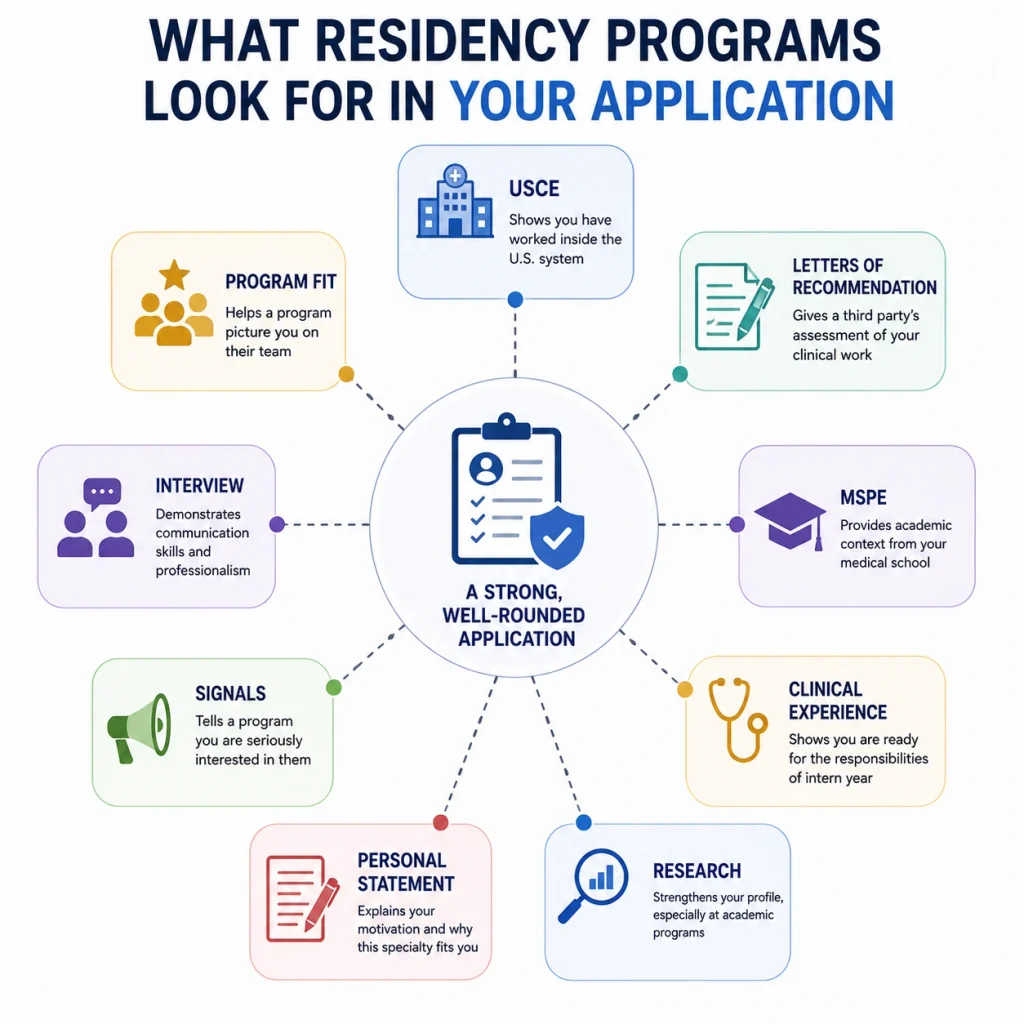
| Application factor | Why it matters |
| USCE | Shows you have worked inside the U.S. system and understand how it runs |
| Letters of recommendation | Gives a third party’s assessment of your clinical work |
| MSPE | Provides academic context from your medical school |
| Clinical experience | Shows you are ready for the responsibilities of intern year |
| Research | Strengthens your profile, especially at academic programs |
| Personal statement | Explains your motivation and why this specialty fits you |
| Signals | Tells a program you are seriously interested in them |
| Interview | Demonstrates communication skills and professionalism |
| Program fit | Helps a program picture you on their team |
The NRMP Program Director Survey is worth reading yourself. It is one of the few places where you can see what programs actually report caring about, rather than what an advice blog assumes they care about.
We place IMGs in electives, observerships and externships with real patient contact and supervisors who write performance-based letters worth reading.
You cannot change the number. You can change almost everything else, and that is where your energy belongs.
Months alone don’t do the work. A program wants to see recent experience, in a setting relevant to the specialty you are applying to, where you had real contact with patients and a supervising physician who can vouch for you. Three focused weeks in a busy internal medicine service can be worth more than six scattered months of shadowing that nobody remembers.
A good clinical letter does something a score cannot. It describes how you work. A letter from a U.S. physician who supervised you, in the specialty you are applying to, gives a program director a reason to look past a number. Generic letters do not do this. Neither do letters from someone who barely worked with you.
Random applying wastes money and time. Before a program goes on your list, check:
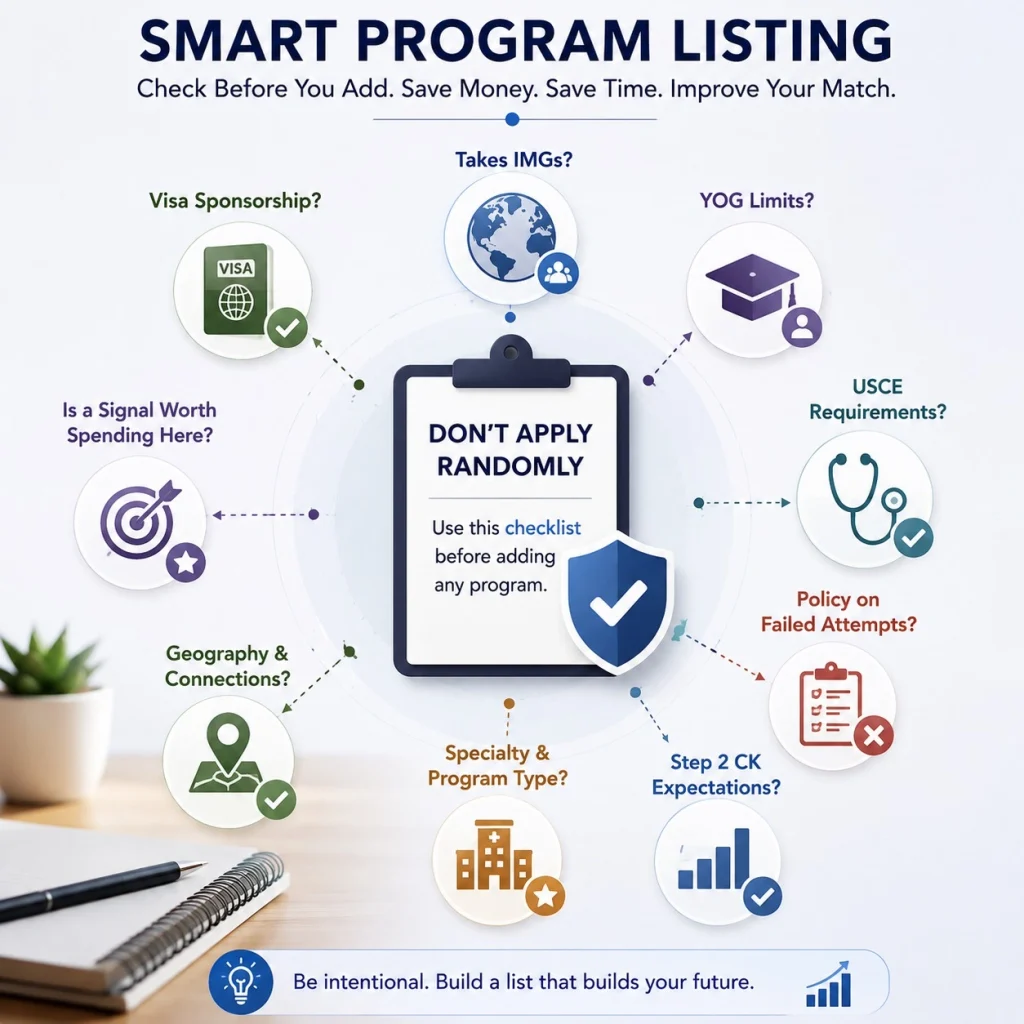
AAMC’s Residency Explorer is the most useful tool most applicants underuse. The current version shows program-level information such as applicant type, signaling data, geographic alignment, previous interview invitation data, and the range of Step 2 CK scores among applicants who were invited to interview in the prior cycle.
That last item is the one to sit with. Instead of guessing whether your score clears a program’s bar, you can look at the range of scores that actually got interviews there.
Most applicants either over-explain or hide. Both hurt.
Your personal statement should sell your candidacy. Spending two paragraphs on a score tells the reader the score is the most important thing about you. It isn’t, unless you make it so.
If a program asks, answer. If there is a designated space on an application to explain something, use it briefly. Otherwise, leave it alone.
Long explanations sound defensive. Two or three sentences is plenty, and it is worth rehearsing them out loud with someone. Our mock interview sessions are built around your specialty and your actual ERAS file.
The interviewer already knows the score. What they don’t know is what you did next.
A simple framework works well here: Acknowledge → Contextualize → Show improvement → Redirect.
Something like this:
“I know my Step 2 CK score is not where I wanted it to be. Since then I’ve focused on strengthening my clinical skills through U.S. clinical experience, and I’ve kept working on my knowledge base and communication. I think my recent clinical performance is a better picture of how I’ll contribute as a resident.”
One more thing. Do not invent excuses, and do not blame your school, your family situation, or your exam center unless you are prepared for the follow-up questions. Interviewers have heard all of it, and a story that sounds rehearsed does more damage than the score.
Step 3 does not erase a Step 2 CK score. Nothing does.
What a passed Step 3 can do is add evidence. It shows that you sat another USMLE exam and passed it, which speaks to your test readiness in a way a single low score does not. Some program directors read it that way. Others barely register it.
Step 3 also carries a practical benefit for some IMGs, because passing it opens the door to programs that sponsor H-1B visas rather than J-1. If visa status is part of your strategy, that alone may justify taking it.
Where applicants go wrong is treating Step 3 as a fix. It is one more piece of a stronger application, alongside USCE, letters, and a smart program list. Take it because it helps your overall profile, not because you expect it to cancel out a number.
It becomes more strategically important, yes. It does not cancel out the score.
Here is why it carries extra weight. A low score raises a question about your readiness. Recent, relevant, hands-on USCE answers that question with something concrete, and it gives you a U.S. physician who can write about your work.
What makes USCE count:
That last point gets ignored. If you cannot describe a patient you followed or a decision you watched being made, the rotation will not help you in the room.
Some specialties have a longer track record of taking IMGs, and their Step 2 CK distributions run lower than the most competitive fields. Worth investigating:
I want to be careful here, because these lists get misread constantly. IMG-friendly does not mean low-score friendly. Psychiatry, for example, has become considerably more competitive over the past several cycles. A specialty that takes many IMGs can still screen heavily on scores.
NRMP’s 2024 data show meaningful differences in Step 2 CK distributions between specialties and between IMG types. Look at the numbers for the specialty you are considering, for your specific applicant category, rather than relying on a general reputation.
If you want detail on any of these fields, our specialty-specific IMG guides go deeper into the requirements and typical applicant profiles.
No. Not necessarily.
The instinct makes sense. If fewer programs will consider you, why not save money? The problem is that a lower score usually means a lower interview rate per application, and cutting your total makes the math worse, not better.
Apply broadly, but apply with a filter. That means:
Every application should have a reason behind it. If you cannot say why a program might interview you, that money is better spent somewhere else. Our 2027 ERAS signaling guide covers how to allocate signals when your profile has a weak spot.
We build program lists against visa, YOG and attempt policies, then review your personal statement so the rest of the file carries the weight your score can’t.
That last one is the most expensive mistake on the list. An application that is never submitted has a zero percent match rate.
Step 1: Identify your realistic specialty options. Look at NRMP data for your applicant type, not general reputation. Be honest about where you fit.
Step 2: Audit program requirements. Build a spreadsheet. Check visa, YOG, USCE, and attempt policies program by program.
Step 3: Build a balanced program list. Community programs, a mix of geography, and a small number of reach programs. Not the other way around.
Step 4: Strengthen your compensating factors. Recent hands-on USCE and strong specialty-specific letters do the heaviest lifting.
Step 5: Apply strategically and prepare for interviews. Place signals with intent, and practice explaining your score in three sentences.
A low Step 2 CK score makes the Match harder. It does not make the Match impossible. The applicants who succeed with lower scores are usually the ones who accepted the situation early and spent their energy on the parts of the application they could still change.
Book a free call with mentors who matched as IMGs. We’ll look at your actual score, specialty and visa situation and tell you where your effort is worth spending.
It is below the average for matched non-U.S. IMGs, so it is fair to call it below average. It is a workable score in several IMG-friendly specialties, especially at community programs.
Yes. Fewer programs will review your application, so apply broadly, choose your specialty carefully, and strengthen your USCE and letters.
Yes, and applicants do so every cycle. Screening filters are your main obstacle, so a well-researched program list matters more than usual.
Yes. This is the most workable of the lower bands, particularly in Internal Medicine and Family Medicine.
There is no universal minimum. You need a passing score to be eligible, and individual programs set their own screening thresholds.
Some do, some don’t, and many do not publish them. Check program websites directly rather than trusting third-party lists.
Yes. Matched IMGs span a wide range of scores. The rest of the application and the program list carry more weight when the score is low.
Not by itself. A passed Step 3 adds evidence of test readiness and can open H-1B sponsoring programs, but it does not replace Step 2 CK.
Briefly and honestly. Acknowledge it, mention what you did afterward, and move the conversation to your clinical work.
It helps, especially when it is recent, hands-on, relevant to your specialty, and produces a strong letter. It does not cancel out the score.
Articles published by IMG Helping Hands are prepared by our team using information from direct experience, publicly available resources, and educational references. AI tools may be used to assist with drafting, proofreading, and formatting; however, all content undergoes review and approval before publication.
The information provided is intended for educational purposes only. Requirements, policies, and processes may change over time. Readers should consult official sources for the most current information.