
You spent two years on Step 1. Maybe another year building research. Then September comes around, you open ERAS, and you fill the whole thing out across one long weekend.
That’s where a lot of interviews quietly disappear.
ERAS isn’t a place to upload documents. It’s the only version of you a program director ever sees before deciding whether to spend an hour talking to you. And a good applicant with a rushed application just reads as average. Here are the ERAS application mistakes that come up over and over, and what to do about each one.
A mid-sized internal medicine program might get four thousand applications for eight or ten spots.
Nobody is reading all of those. Filters cut the pile first. Whatever survives gets a fast human scan, and “fast” here often means under a minute.
In that minute, a vague experience description or a date that doesn’t match your CV stands out much more than you’d think. It isn’t only that it looks careless. It makes the reviewer work harder to figure out who you are, and a reviewer on their ninetieth file that evening simply moves on to the next one.
So plenty of qualified IMGs get cut here. Not for lack of scores. The application just never made the case clearly enough.
We read your ERAS the way a program director will, then show you exactly where a fast scan loses the thread, before you certify.
You’ve seen this version. It reads like a job description lifted from a hospital handbook. Took histories. Performed physical exams. Presented cases on rounds.
Every single applicant did that. The reviewer learns nothing about you.
Three things belong in every entry: what you were responsible for, what you actually contributed, and what you walked away with. Numbers do a lot of work here. “Managed a 20-bed medical ward” lands differently than “managed patients.”
Start with an action verb. Not “responsible for.” And across your entries as a whole, make sure someone can see that you’ve led a team, worked inside one, sat with a family through bad news, and carried patient care on your own. For entry-by-entry examples, see our guide on how to write strong ERAS experiences. Those are the signals programs are actually reading for.
Most people pick whatever sounds most impressive on paper. A research fellowship somewhere well-known. A conference in the States.
But the question isn’t what was prestigious. It’s what was meaningful.
Here’s a quick test: if you can’t explain how the experience changed the way you think or practice, pick something else. A year as a medical officer in an understaffed emergency room. A volunteer clinic where you had to reason without labs. One difficult patient you followed for months. These usually make far better entries, because you have something real to say about them.
For IMGs, this section carries more weight than almost anything else on the application. It’s also, very often, the weakest part.
Be specific about the type. An observership, a hands-on externship, and a sub-internship are three different things, and reviewers know exactly which is which, our guide on how these USCE types compare explains what each signals. Name the type, name the setting, and describe what you actually did with your hands and your head.
“Observed in outpatient cardiology” tells them nothing.
“Followed 8 to 10 clinic patients daily, presented to the attending, drafted notes for review” tells them what you can handle on day one of the intern year.
Hands-on US rotations give you specific, describable clinical experience, and the US letters that make an ERAS file land.
Reviewers notice when things don’t line up. The usual culprits:
On their own, none of these are serious. Together, they make someone wonder what else in the file is inaccurate, and that kind of doubt is very hard to undo later.
Build one master timeline in a spreadsheet. Copy every date from it. Never from memory.
ERAS has specific categories for a reason, and putting something in the wrong one reads as either confusion or padding. Neither helps you.
Get these clear:
Posters count. Oral presentations count. So do presentations you gave inside your own institution, work presented at national or international conferences, and virtual presentations. Each of these has its own category, so put them where they belong instead of dumping everything under one heading.
Program directors in research-heavy specialties do check some of this. Listing a submitted manuscript as published isn’t a small error, it’s the kind that ends an application. When you’re not sure, go with the more conservative category.
Applicants chase titles. It’s understandable, and it backfires.
A department chair who met you twice writes a polite letter that says nothing. The attending you worked under for six weeks writes something specific and genuinely useful. Take the second one every time.
Two other things worth knowing. US letters carry more weight than home-country letters at most programs, so get one or two if you possibly can. And give every writer a packet: your CV, your personal statement, the specialty you’re applying to, and a short reminder of what you did together. Don’t make a busy attending reconstruct it from memory.
The usual ERAS red flags: long gaps with no explanation, multiple attempts on a Step exam, several years since graduation with no clinical work, incomplete sections, thin letters, a personal statement that could belong to anyone.
Having one isn’t the mistake. Most IMGs have at least one. The mistake is acting like nobody will notice.
A gap you explain honestly in two sentences stops being a mystery. A failed attempt followed by a strong score and a clear account of what you changed actually reads as resilience. Silence does the opposite. It leaves the reviewer to fill in the blank themselves, and people tend to imagine the worst version.
Address what you can. Briefly, and without excuses.
A statement that could belong to any applicant in any specialty isn’t doing anything for you.
The pattern is familiar. The same essay sent to internal medicine and pediatrics with the specialty name swapped out. A general interest in helping people instead of an actual reason for choosing this field. Claims with nothing underneath them.
“I am compassionate” is telling. A short account of the patient you stayed two hours late for is showing. Pick one or two real moments and write them properly, our guide on how to write a standout personal statement walks through turning those moments into a full essay. For the handful of programs you truly want, one specific line about why that program fits is worth the extra time.
For the handful of programs you truly want, one specific line about why that program fits is worth the extra time. For the other hundred, it isn’t.
Plenty of programs sponsor only one visa type. Some sponsor none at all. It’s one of the first things a coordinator checks. Answer the visa questions accurately, and don’t leave them blank hoping it slides. If you’re eligible for both J-1 and H-1B, say so, because that widens your list considerably, and if you’re not sure which applies to you, our breakdown of J-1 vs H-1B for IMG residency explains the difference.
It looks like a throwaway field. It isn’t.
Interviewers scan it looking for something to open with, and applicants who fill it thoughtfully tend to have easier, warmer interviews. Leave it blank and you’ve handed the interviewer nothing to work with.
Write something real and specific. “Long-distance running, cooking Punjabi food, amateur astronomy” beats “reading, traveling, music,” which is roughly what half the applicant pool writes. One caution: don’t list anything you can’t talk about for two minutes if asked.
Small things. Easy to fix. Still surprisingly common.
Your photo should be a plain professional headshot, neutral background, clinical or formal attire. Not a cropped wedding photo. Not a selfie in your car. Not a picture from five years and one hairstyle ago.
Use an email address that’s just your name in some clean, formal arrangement.
And check your phone number. Include the country code, and confirm the line actually works. People have missed interview invitations over exactly this.
Applying broadly and applying well are not the same thing. Two hundred programs picked at random will do worse than eighty picked carefully.
Filter on what actually predicts an interview: does the program sponsor your visa, have they matched IMGs in the last few years, what’s their year-of-graduation limit, do they publish a minimum score.
Then build a real spread. A few reaches. A solid middle group where your profile genuinely matches their recent match list. And some honest safety programs. Our list of top IMG-friendly programs with visa sponsorship and score cutoffs is a good starting point for that middle group. Almost all of this is public information. Look it up before you pay.
Book a free call and we’ll help you build a list around visa fit, IMG match history, and score cutoffs, and place your signals where they actually count.
Signals tell a program you’re seriously interested, and you only get a few. Programs use them to decide who gets a closer read, so placement matters.
Two mistakes show up constantly. Some applicants never use their signals at all. Others burn every one on famous academic programs that were never going to interview them.
Signal where you have a real connection or a strong profile match. And check the current rules for your specialty each cycle, because the number and the structure keep changing.
September is the worst possible time to discover a problem.
Transcripts take weeks. Letter writers go on leave. ECFMG requests sit in a queue. Uploads fail on the one day everyone in the world is uploading.
Leave it all to the final week and you’ll end up proofreading at 2 a.m. and certifying an application you haven’t really read.
Start in June. Ask for letters in July, then follow up politely in August. Request every document earlier than you think you need it. That buffer is the whole point, because it’s what lets you fix problems calmly instead of in a panic.
Once you certify, most of it is locked.
So before you do: hunt for typos and inconsistent formatting, confirm you selected the right specialties, check that every document you expected is actually attached, and verify your email and phone number.
Then hand it to someone else. By your tenth pass you’re skimming your own errors without seeing them. A mentor, a senior resident, even a careful friend outside medicine will catch things you’ve gone blind to.
Ask ten rejected applicants why IMGs don’t get interviews and nine will point straight at their scores. Sometimes that’s the honest answer. Often it isn’t.
What actually sinks applications is less dramatic. No clear thread connecting your training to the specialty you chose. Experience descriptions that list duties instead of showing ability. Dates that contradict each other. An application indistinguishable from a thousand others. Obvious errors. Missing documents. A program list built without ever checking whether those programs take applicants like you.
Most programs now use holistic review, which means the whole file gets read, not just the score line. Your experiences, your statement, your letters, your accuracy, all of it feeds the decision.
Put plainly: a 250 with a careless application loses to a 235 with a sharp one.
Go through this before you certify.
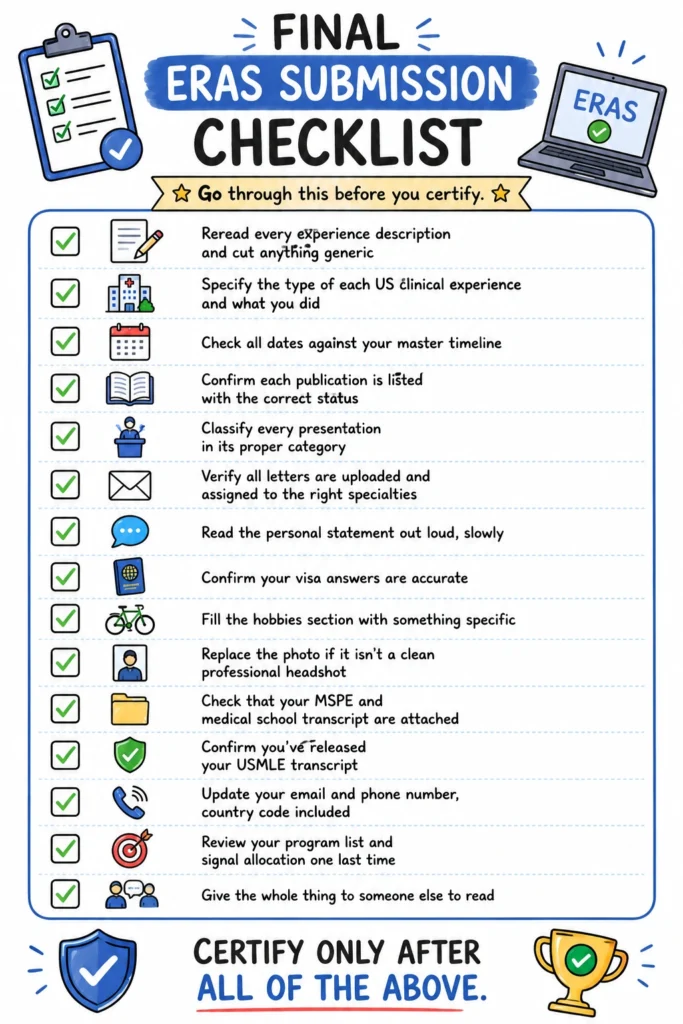
None of these are hard to fix. That’s exactly what makes them frustrating when they cost someone an entire interview season.
Your ERAS application is the only version of you a program has before they decide. When it’s accurate, specific, and honest, it does the one job it needs to do, which is help them understand what you’d bring to their program.
So start earlier than feels necessary. Read every section as though a stranger wrote it. Get two people you trust to look it over. Then certify, and put the rest of your energy into interview prep.
Only partly. After you certify and submit, you can still change your personal statement assignments, letter assignments, and program list. The core application, meaning your experiences, publications, and personal information, is locked. That’s why the final review matters as much as it does.
Posters, oral presentations, institutional presentations, and work presented at national, international, or virtual conferences all count. List each one under its correct category rather than grouping them together.
Yes, if the gap runs longer than a few months. A brief honest explanation beats leaving it open to interpretation. Clinical work, exam prep, research, family responsibilities, and visa delays are all common and perfectly reasonable.
There’s no required number. Ten strong entries beat twenty thin ones. Include what’s relevant to your specialty and describe it properly.
They can. Errors rarely cause a rejection by themselves, but they weaken your file at the exact moment someone is deciding quickly. In a competitive pile, that’s usually enough.
Your ERAS is the only version of you a program sees before they decide. Most of these mistakes are invisible to the person who made them, which is exactly why a second set of expert eyes matters. Here’s what we do:
Articles published by IMG Helping Hands are prepared by our team using information from direct experience, publicly available resources, and educational references. AI tools may be used to assist with drafting, proofreading, and formatting; however, all content undergoes review and approval before publication.
The information provided is intended for educational purposes only. Requirements, policies, and processes may change over time. Readers should consult official sources for the most current information.