

Clinical experience is one of the first things medical schools look at. So here’s the short answer. There’s no set minimum in the U.S. Most people who get in have around 150 to 300 hours. Some have more. Sometimes it’s 1,000 or more, usually from a job or a volunteer role they stuck with for a while. But the number isn’t really the point. Schools just want to see that your hours were real. They want to know you showed up, stayed with it, and learned something.
Clinical hours are just the time you spend around patients. That’s it. You’re either helping care for people, or you’re right there watching it happen.
The point is simple. These hours show you know what patient care really looks like. Not from a book. Not from a TV show. From being in the room. They also show you what a doctor does all day. And they prove you’re serious about medicine, because you’ve already put in the time.
A few words get mixed up a lot. So let’s keep them straight:
All of these help your application. But they don’t count for the same thing. Mix them up, and you can look careless. So it’s worth knowing the difference early.
Most medical schools expect clinical experience. A lot of them just don’t say so on their website. So on paper, the answer is often no. In real life, it’s yes. Showing up without any is one of the fastest ways to weaken a good application.
The reason is easy. Schools want to know you’ve seen what medicine is really like. And that you still want in. It’s a hard job. It can be messy. It’s nothing like the clean version on screen. Time with sick or scared patients tells them one thing. You’ve seen the real thing, and you didn’t run.
So don’t treat clinical hours as optional. If they’re missing, no essay can fully make up for it.
This is the one that keeps premeds up at night. So let’s be straight. There’s no official number. Schools leave it vague on purpose. But look at the people who actually get in. You’ll see clear patterns. Those give you real targets.
Here’s a simple guide:
| Applicant Strength | Approximate Clinical Hours |
| Minimum exposure | 100–150 |
| Competitive | 150–300 |
| Highly competitive | 300–1,000+ |
The total matters less than you’d think. Two other things matter more. The first is consistency. A school would rather see you show up every week for a year. That beats packing 300 hours into one summer and then vanishing. Stick with something long enough to grow into it. That counts for far more than a bunch of scattered, one-time activities.
When you apply matters too. People taking a gap year usually get more hours. That’s just because a full-time job can add over 1,000 in a single year. So the averages online can look scary. If you’re a full-time student, nobody expects you to hit those.
So how many hours do you need? Go for steady and meaningful over huge. Two hundred solid hours you can talk about will beat 600 empty ones. Almost every time.
To a medical school, clinical experience means one thing. You were with patients, or you watched their care up close. The best kind is hands-on care. But a lot of jobs count. Here’s what does, and why:
The thread is simple. It’s real time with patients. So pick a role that puts you in the room, not just the building.
This is where people get confused. So let’s make it clear. Clinical hours are the ones where you’re part of a patient’s care. Or watching it closely.
These usually count:
These usually don’t:
Here’s the quick test. Were you near a patient? Did you help care for them or talk with them? If yes, it probably counts. If you spent the whole shift behind a screen, it probably doesn’t. It doesn’t matter how useful the skill was. Get this right. Schools spot the wrong labels fast.
Yes. Scribing counts. And it’s one of the best roles you can pick. On the AMCAS application, it’s listed right under clinical experience. It sits next to jobs like EMT work.
Why does it count so clearly? Because you’re in the exam room for real visits. You watch doctors work through symptoms. You see them order tests and explain what’s going on. And you write it all down as it happens. You get a front-row seat to how doctors think. You pick up all the medical terms too. That’s exactly what schools want to see. It also gives you real stories for your essays and interviews. Not many starter jobs get you that close.
Yes. EMT work counts. And schools tend to think highly of it. It’s about as hands-on as a premed job gets.
As an EMT, you care for patients in real emergencies. You often decide fast, with very little to go on. You learn to stay calm. You learn to talk to people who are scared, hurt, or very sick. You get used to being useful when things are tense. That mix of independence, steadiness, and real patient contact is why it’s such an easy yes. The hours can be rough. The schedule can be all over the place. But it gives you honest, memorable material for your application.
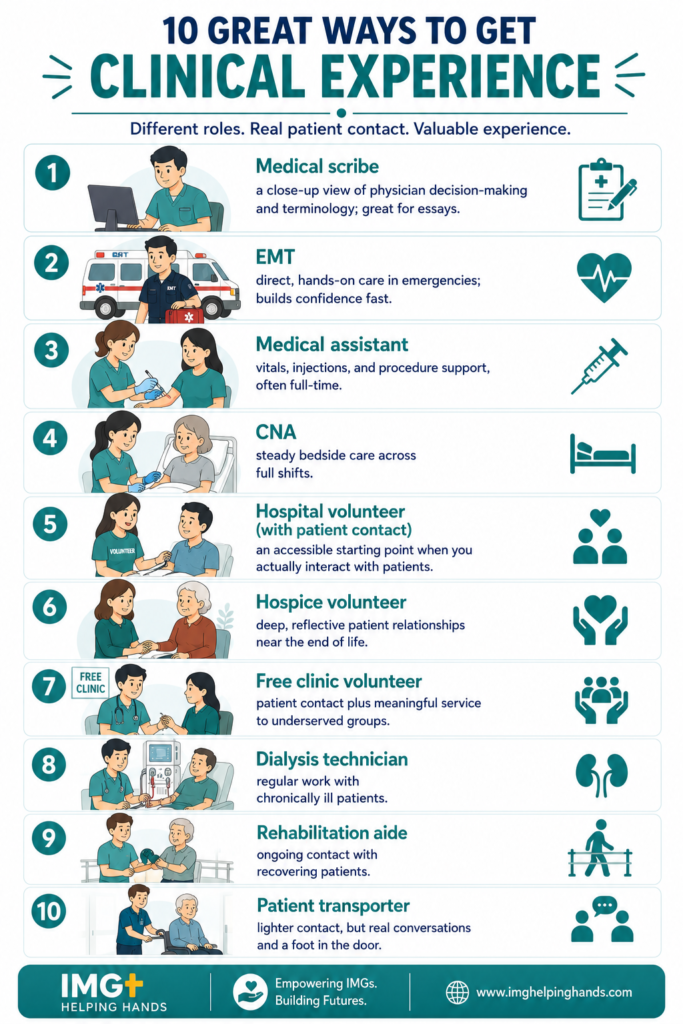
There’s no single best path. But some roles reliably give you strong hours. Here’s a rough ranking. It’s based on how much patient contact you get, and what you’ll walk away with:
To find these, start close to home. Look at hospitals, clinics, hospice groups, campus EMS teams, and community health centers. Want something easy to start with? Hospital volunteering or shadowing works fine. Ready for more? EMT, scribe, CNA, or phlebotomy jobs pay you while you build hours. Whatever you pick, choose something you can stick with. That’s what turns a pile of hours into a real story.
For international medical graduates, hands-on US clinical experience does more than fill hours, it earns the letters programs trust.
There’s no set number here either. But schools still want to see volunteering. A lot of strong applicants finish with 100 to 300 or more non-clinical volunteer hours. That’s spread over their premed years.
It helps to split volunteering into two kinds. The first is clinical volunteering, like helping at a free clinic. That counts toward your clinical hours. The second is community volunteering. Think tutoring, a food bank, or a shelter. That says something different. It shows you care about people and give back. Both matter. Schools built around service really value the community kind.
So how many volunteer hours do you need? Go for steady, real involvement. Skip the last-minute rush. Schools can tell the difference between someone who cares and someone just checking a box.
For shadowing, about 40 to 100 hours is a common goal. A lot of advisors say 40 to 50 is a fine place to land. A few schools list their own numbers. So check the sites of the programs you care about.
Try to shadow more than one kind of doctor. Follow a family doctor, a surgeon, and a pediatrician. That gives you a much fuller picture than just one. Remember, shadowing is watching, not doing. It goes well next to hands-on experience. But it can’t take its place. It also sits in its own spot on your application, apart from clinical work. So log it honestly.
Usually, no. Research and clinical experience are two different things. Don’t blur them. Lab work and data help your application. But they don’t put you in front of a patient. So they won’t fill your clinical bucket.
There’s one gray area. Some research puts you with patients. You might get their consent or collect their health info. That can include some real clinical contact. Even then, it usually shouldn’t replace regular clinical experience. So treat research as a nice extra. Not a stand-in for real time with patients.
A few habits quietly drag down good applications:
The fix is the same for all of them. Start early. Stay steady. And really pay attention to what your experiences teach you. Schools read for what you learned. Not just your totals.
There’s no fixed number. But 150 to 300 is a solid range. Steady, meaningful hours matter more than the total.
Yes, if you’re with patients. A free clinic is a good example. Regular community volunteering counts on its own, separately.
No. Shadowing is watching. It sits in its own spot, apart from hands-on work.
No. Research helps. But it doesn’t involve caring for patients. So it can’t take the place of clinical work.
Hospital volunteering, where you actually talk to patients. It’s one of the simplest ways to start.
Not always on paper. But almost all expect it. So treat it as a must.
About a year in a full-time clinical job. That’s why a lot of gap-year applicants end up with high totals.
IMG Helping Hands guides students and match applicants alike, with honest, step-by-step help and free resources.
Here’s the honest version. There’s no magic number of clinical hours. Aim for real, steady time with patients. Don’t chase a figure. Around 150 to 300 hours makes you competitive. But 200 hours you can actually talk about will beat 600 empty ones. Round it out with some shadowing, community service, and a bit of research. And more than anything, think about what each experience taught you. Schools care about that just as much as the hours. Start early. Keep at it. And let your story carry the weight.
No matter if you are a medical student or a match applicant, IMG Helping Hands is present to guide at every step. Keep following our blog section if you want more updates and free guidance about your medical journey.
IMG HELPING HANDS – GUIDANCE AT EVERY STAGE
Whether you’re building your first clinical hours or you’re an international medical graduate working toward the Match, IMG Helping Hands is here to guide the next step, from hands-on US clinical experience to research, ERAS, and interview season. Honest advice, built for where you actually are.
Keep following our blog for free guidance on your medical journey.
Articles published by IMG Helping Hands are prepared by our team using information from direct experience, publicly available resources, and educational references. AI tools may be used to assist with drafting, proofreading, and formatting; however, all content undergoes review and approval before publication.
The information provided is intended for educational purposes only. Requirements, policies, and processes may change over time. Readers should consult official sources for the most current information.