
Autonomic nervous system pharmacology is the single most cross referenced topic on USMLE Step 1. It shows up in physiology, pathology, clinical vignettes, ethics, and even behavioral science questions. Most IMGs treat it like a memorization grind. That approach fails because NBME never tests direct recall. It tests pattern recognition.
The real problem is not the volume of drugs. It is the absence of a visual system that maps every receptor, every drug, and every toxicity into patterns you can recognize in under 10 seconds on test day. This guide was built from actual NBME question analysis to be exactly that system. If something appears in this document, it has been tested or it will be.
| EXAM PEARL USMLE tests ANS pharmacology through clinical scenarios, not name the receptor questions. You will see a patient with specific symptoms and must identify the drug, mechanism, or toxicity from clinical context. |
ANS drugs integrate across every organ system, which is exactly why the NBME relies on them so heavily. A single question stem can simultaneously test receptor physiology, drug mechanism, toxicity, and clinical decision making. Understanding the logic behind these drugs eliminates the need to memorize hundreds of isolated facts.
The exam rarely asks you to name a receptor directly. Instead, it describes what happens to an organ when a drug is given and expects you to work backwards to the receptor and mechanism. Here are the most common formats you will encounter.
Before touching any drug, you need to own the wiring diagram. Every ANS drug either mimics, blocks, or modifies what happens at specific receptors in specific organs. Once you internalize this architecture, drug actions become predictable instead of random facts. The diagram below maps the entire system at a glance.
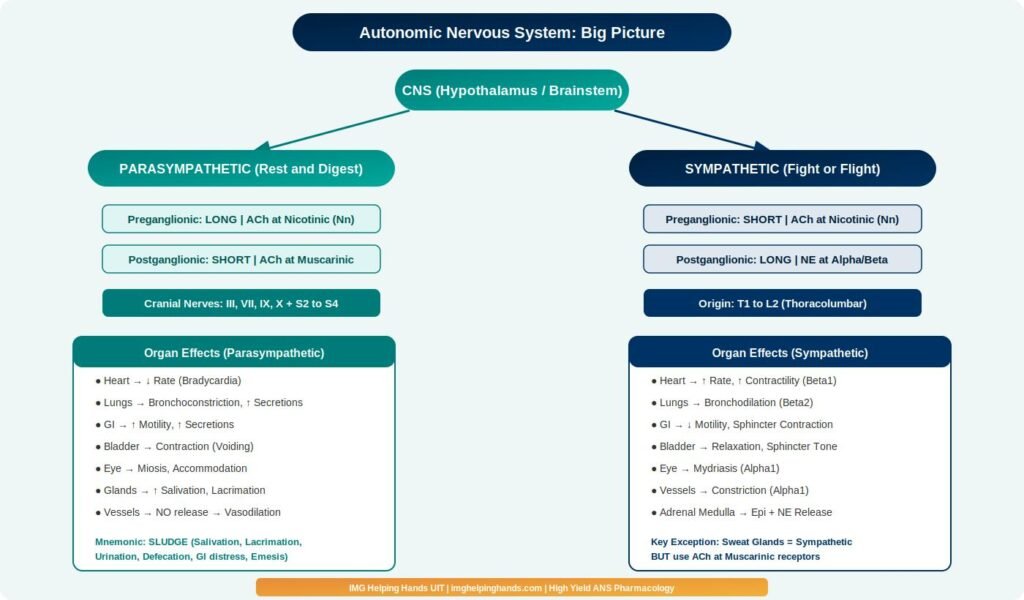
This table is the foundation of everything that follows. Notice that both sympathetic and parasympathetic preganglionic neurons use ACh at nicotinic Nn receptors. The key difference is what happens after the ganglion. Parasympathetic postganglionic neurons release ACh at muscarinic receptors, while sympathetic postganglionic neurons release norepinephrine at alpha and beta receptors.
| Division | Postganglionic NT | Postganglionic Receptor |
|---|---|---|
| Parasympathetic | ACh | Muscarinic (M1 to M5) |
| Sympathetic | Norepinephrine | Alpha1, Alpha2, Beta1, Beta2 |
| Somatic Motor | ACh | Nicotinic (Nm) |
| Adrenal Medulla | Epi + NE (into blood) | Systemic Alpha and Beta |
All preganglionic fibers in both divisions use ACh acting on nicotinic Nn receptors. The adrenal medulla acts as a modified sympathetic ganglion, releasing epinephrine and norepinephrine directly into the bloodstream.
| EXAM PEARL Sympathetic sweat glands are the classic exception. They are innervated by sympathetic fibers but use ACh acting on muscarinic receptors. NBME tests this almost every year. |
This receptor map is the single most important reference in ANS pharmacology. Every drug mechanism, every toxicity, and every clinical scenario traces back to which receptor is being stimulated or blocked and what G protein cascade it triggers. Learn this chart and you can reverse engineer any board question.
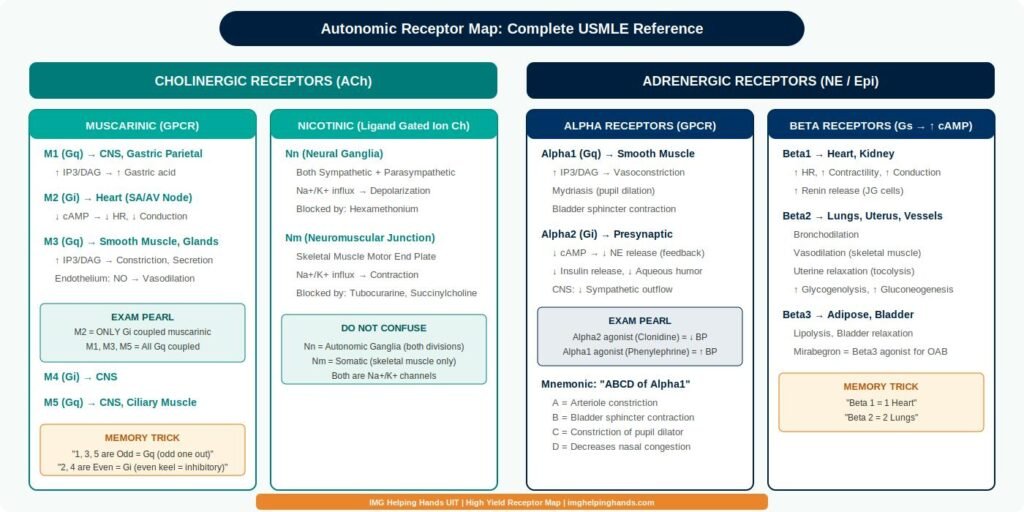
The G protein coupling determines the downstream effect. Gq receptors activate phospholipase C, generating IP3 and DAG, which causes smooth muscle contraction and gland secretion. Gs receptors activate adenylyl cyclase, raising cAMP, which relaxes smooth muscle and increases cardiac activity. Gi receptors inhibit adenylyl cyclase, lowering cAMP, which slows the heart and reduces neurotransmitter release.
| Receptor | G Protein / Cascade | Key Effect and Location |
|---|---|---|
| M1 | Gq (IP3/DAG) | Gastric acid secretion. CNS, Gastric parietal cells |
| M2 | Gi (decreases cAMP) | Decreases HR and conduction. Heart SA/AV node |
| M3 | Gq (IP3/DAG) | Smooth muscle contraction, Secretions. Glands, Endothelium |
| Alpha1 | Gq (IP3/DAG) | Vasoconstriction, Mydriasis. Vascular smooth muscle |
| Alpha2 | Gi (decreases cAMP) | Decreases NE release (feedback). Presynaptic terminals |
| Beta1 | Gs (increases cAMP) | Increases HR, Contractility, Renin. Heart, Kidney |
| Beta2 | Gs (increases cAMP) | Bronchodilation, Vasodilation. Lungs, Uterus, Vessels |
| Beta3 | Gs (increases cAMP) | Lipolysis, Bladder relaxation. Adipose, Bladder |
| D1 | Gs (increases cAMP) | Vasodilation. Renal and mesenteric vessels |
A quick way to remember the muscarinic G protein pattern: odd numbered receptors (M1, M3, M5) are Gq coupled, while even numbered receptors (M2, M4) are Gi coupled. For beta receptors, all three subtypes couple to Gs and increase cAMP.
| DO NOT CONFUSE Alpha1 and Alpha2 have opposite clinical effects when agonized. Alpha1 agonists raise BP through vasoconstriction. Alpha2 agonists lower BP by reducing sympathetic outflow from the CNS. The NBME loves this distinction. |
The cholinergic system uses one neurotransmitter, acetylcholine, acting on two receptor families: muscarinic (G protein coupled, slower) and nicotinic (ligand gated ion channels, faster). Drugs in this category either activate these receptors directly, prevent ACh breakdown to amplify its effects, or block the receptors entirely. Understanding this three way classification makes the entire system manageable.
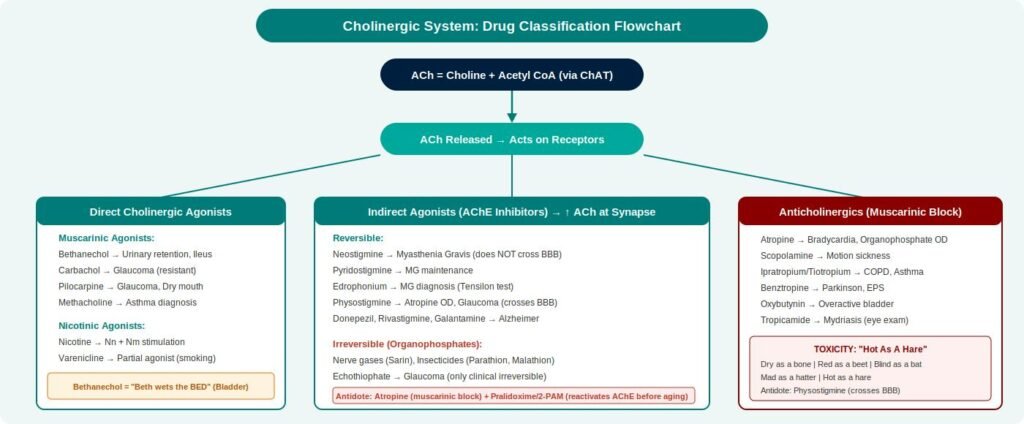
These drugs bind directly to muscarinic receptors and mimic the action of ACh. They are used clinically when you need to stimulate parasympathetic target organs. The most commonly tested ones each have a single high yield clinical association that appears in NBME stems.
| Drug | Clinical Use | USMLE High Yield Clue |
|---|---|---|
| Bethanechol | Urinary retention, Ileus | Stimulates bladder and GI without nicotinic effects |
| Carbachol | Resistant glaucoma | Dual muscarinic + nicotinic agonist. Resists AChE |
| Pilocarpine | Open angle glaucoma, Dry mouth | Contracts ciliary muscle. Opens trabecular meshwork |
| Methacholine | Asthma provocation test | Bronchoconstriction only in hyperreactive airways |
Bethanechol is the classic answer when a postoperative patient cannot void or has no bowel sounds. Think of it as ‘Beth wets the BED’ for bladder and bowel activation. Methacholine is never used as treatment. It is purely a diagnostic tool to confirm airway hyperreactivity.
Instead of activating receptors directly, these drugs block acetylcholinesterase, the enzyme that normally breaks down ACh. This allows ACh to accumulate at the synapse and produce a stronger, longer effect at both muscarinic and nicotinic receptors. The critical distinction within this group is whether the inhibition is reversible or irreversible.
| Drug | Key Feature | Clinical Use |
|---|---|---|
| Neostigmine | Reversible. Does NOT cross BBB | Myasthenia gravis treatment. NMJ blockade reversal |
| Pyridostigmine | Reversible. Does NOT cross BBB | MG long term maintenance |
| Edrophonium | Reversible. Ultra short acting | MG diagnosis (Tensilon test). Rapid onset 30 sec |
| Physostigmine | Reversible. CROSSES BBB | Anticholinergic OD (treats CNS + peripheral) |
| Donepezil | Reversible. Crosses BBB | Alzheimer disease. Most tested AChEI for dementia |
| Organophosphates | IRREVERSIBLE | Insecticides (Parathion), Nerve agents (Sarin) |
The BBB distinction between Physostigmine and Neostigmine is one of the most tested pharmacology facts on Step 1. If the patient has central anticholinergic symptoms like confusion and hallucinations, only Physostigmine will work because it crosses into the brain. Neostigmine stays in the periphery.
| EXAM PEARL Organophosphates form a covalent bond with AChE. This bond ‘ages’ over 24 to 48 hours and becomes permanent. Pralidoxime (2 PAM) can reactivate the enzyme only if given before aging occurs. After aging, the enzyme is permanently destroyed. |
This is among the most commonly tested toxicology scenarios on both Step 1 and Step 2 CK. The key to answering these questions correctly is recognizing the clinical picture and understanding the treatment protocol. Organophosphates irreversibly inhibit AChE, causing massive ACh accumulation at all cholinergic synapses, both muscarinic and nicotinic.
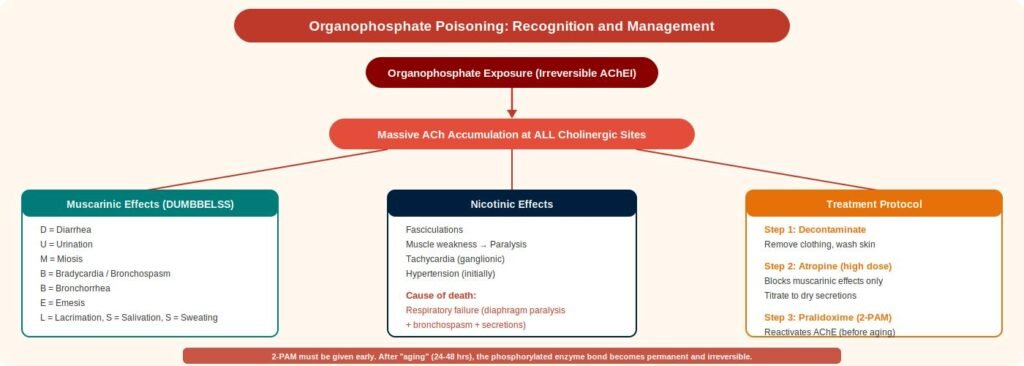
This mnemonic captures the muscarinic symptoms that dominate the clinical picture. When you see a combination of these findings in a question stem, especially in a farmer or agricultural worker, organophosphate poisoning should be your immediate thought.
| Letter | Finding | Mechanism |
|---|---|---|
| D | Diarrhea | M3 on GI smooth muscle |
| U | Urination | M3 on detrusor muscle |
| M | Miosis | M3 on sphincter pupillae |
| B | Bradycardia | M2 on SA/AV node |
| B | Bronchospasm | M3 on airway smooth muscle |
| E | Emesis | M on CTZ and GI tract |
| L | Lacrimation | M3 on lacrimal glands |
| S | Salivation | M3 on salivary glands |
| S | Sweating | Muscarinic sympathetic fibers |
The nicotinic effects, including fasciculations, muscle weakness, and eventual paralysis, are equally important but not captured by this mnemonic. Death in organophosphate poisoning results from respiratory failure: diaphragm paralysis (nicotinic) plus bronchospasm plus excessive airway secretions (both muscarinic).
Treatment follows a strict protocol. Decontaminate first (remove clothing, wash skin). Give high dose Atropine to block muscarinic effects and titrate until secretions dry. Then give Pralidoxime (2-PAM) to reactivate AChE before the enzyme ages. Atropine does NOT reverse nicotinic effects such as muscle paralysis.
Anticholinergics block muscarinic receptors, producing effects that are the exact opposite of cholinergic stimulation: decreased secretions, increased heart rate, bronchodilation, urinary retention, and mydriasis. The toxicity profile of these drugs creates one of the most recognizable clinical patterns on USMLE.
Each drug in this class has a specific clinical niche. Knowing which anticholinergic goes with which clinical scenario is more valuable than memorizing generic receptor binding profiles.
| Drug | Primary Use | Key Consideration |
|---|---|---|
| Atropine | Bradycardia, OP poisoning | Blocks muscarinic only. NOT nicotinic |
| Scopolamine | Motion sickness | Transdermal patch. Strong CNS penetration |
| Ipratropium | COPD, Acute asthma | Inhaled. Minimal systemic effects |
| Tiotropium | COPD maintenance | Long acting inhaled anticholinergic |
| Benztropine | Drug induced EPS, Parkinson | Reduces tremor and rigidity from DA blockade |
| Oxybutynin | Overactive bladder | Reduces detrusor contractions. Common dry mouth |
| Tropicamide | Mydriasis for eye exams | Short acting. Primarily diagnostic use |
| Glycopyrrolate | Preop secretion reduction | Quaternary amine. Does NOT cross BBB |
Ipratropium deserves special attention because it is inhaled and acts locally in the airways with minimal systemic absorption. This makes it useful in patients who cannot tolerate systemic anticholinergic effects. In contrast, Oxybutynin is a common cause of anticholinergic toxicity in elderly patients, frequently appearing in questions about new onset delirium.
The classic mnemonic paints a vivid clinical picture that USMLE tests repeatedly. Understanding why each symptom occurs makes it easier to distinguish anticholinergic toxicity from other toxic syndromes on exam day.
| Mnemonic | Finding | Mechanism |
|---|---|---|
| Hot as a hare | Hyperthermia | Blocked sweat glands (muscarinic) |
| Dry as a bone | Anhidrosis, Dry mouth | Muscarinic blockade of all glands |
| Red as a beet | Flushed skin | Cutaneous vasodilation |
| Blind as a bat | Mydriasis, Cycloplegia | Blocked M3 on iris and ciliary muscle |
| Mad as a hatter | Confusion, Hallucinations | Central muscarinic blockade in brain |
| Full as a flask | Urinary retention | Blocked detrusor contraction |
The fastest way to differentiate on exam day: anticholinergic toxicity produces a hot, dry, confused patient. Cholinergic toxicity produces a cold, wet patient drowning in secretions. This single distinction solves most toxicology questions involving these drug classes.
| EXAM PEARL Antidote for anticholinergic toxicity is Physostigmine (an AChE inhibitor that crosses the BBB). It reverses both central symptoms (delirium) and peripheral symptoms (tachycardia, dry mouth). Do NOT use Neostigmine for central toxicity. |
The adrenergic system uses norepinephrine and epinephrine acting on alpha and beta receptors. These receptors control vascular tone, heart rate, airway caliber, and metabolic responses. The number of drugs in this category can feel overwhelming, but they all follow a logical framework based on which receptor they target and whether they activate or block it.
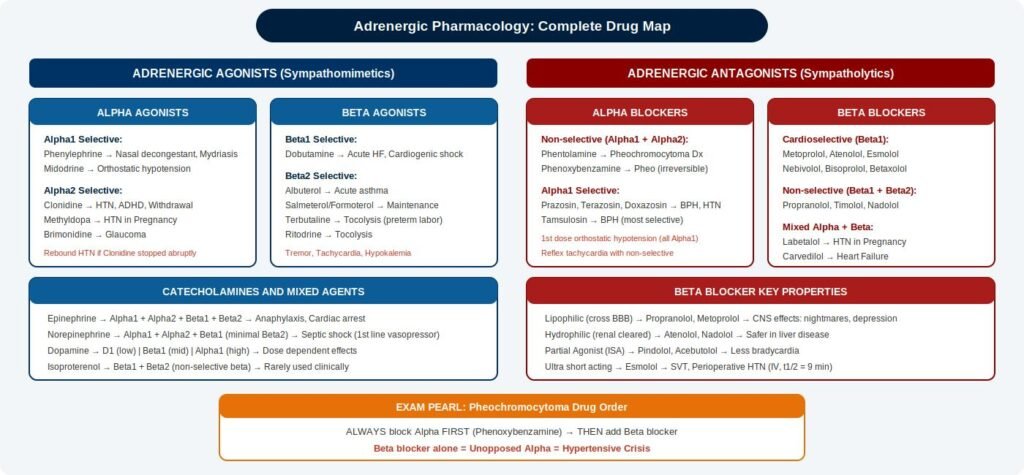
Alpha agonists are divided by receptor selectivity. Alpha1 agonists cause vasoconstriction and are used to raise blood pressure or relieve nasal congestion. Alpha2 agonists work centrally to reduce sympathetic outflow, effectively lowering blood pressure through a completely different mechanism.
| Drug | Receptor | Clinical Use |
|---|---|---|
| Phenylephrine | Alpha1 selective | Nasal decongestion, Hypotension, Mydriasis |
| Midodrine | Alpha1 selective | Orthostatic hypotension |
| Clonidine | Alpha2 selective (central) | HTN, ADHD, Opioid withdrawal |
| Methyldopa | Alpha2 selective (central) | HTN in pregnancy (1st line) |
| Brimonidine | Alpha2 selective | Open angle glaucoma |
Clonidine must never be stopped abruptly because the sudden loss of central sympathetic suppression causes rebound hypertension that can be severe. USMLE tests this as a patient whose blood pressure spikes after noncompliance or sudden discontinuation. Methyldopa is the classic answer for chronic hypertension management during pregnancy.
Beta1 agonists increase heart rate and contractility. Beta2 agonists relax bronchial and uterine smooth muscle. The clinical applications follow directly from these effects.
| Drug | Selectivity | Clinical Use |
|---|---|---|
| Dobutamine | Beta1 selective | Acute HF, Cardiogenic shock (inotrope) |
| Albuterol | Beta2 selective | Acute asthma (rescue inhaler) |
| Salmeterol / Formoterol | Beta2 selective (long acting) | Asthma / COPD maintenance |
| Terbutaline | Beta2 selective | Tocolysis (preterm labor) |
| Isoproterenol | Non selective (Beta1 + Beta2) | Rarely used. Research context |
Beta2 agonists cause three predictable side effects: tremor (skeletal muscle Beta2), tachycardia (reflex or direct Beta1 stimulation at higher doses), and hypokalemia (Beta2 drives potassium into cells). These side effects appear frequently in NBME stems as clues to identify the drug class.
These drugs activate multiple receptor types simultaneously. Their clinical effects depend on which receptors are dominant at the given dose, making dose dependent pharmacology a critical concept for the exam.
| Drug | Receptors Activated | Primary Clinical Use |
|---|---|---|
| Epinephrine | Alpha1 + Alpha2 + Beta1 + Beta2 | Anaphylaxis (IM), Cardiac arrest |
| Norepinephrine | Alpha1 + Alpha2 + Beta1 (minimal Beta2) | Septic shock (1st line vasopressor) |
| Dopamine (low) | D1 (renal vasodilation) | Renal perfusion (controversial) |
| Dopamine (medium) | Beta1 (cardiac stimulation) | Cardiogenic shock |
| Dopamine (high) | Alpha1 (vasoconstriction) | Severe refractory hypotension |
Dopamine is unique because its receptor target shifts with dose escalation. At low doses it primarily hits D1 receptors causing renal vasodilation. At medium doses it activates Beta1 for cardiac output. At high doses it recruits Alpha1 for vasoconstriction. USMLE tests this dose dependent concept regularly.
Alpha blockers are divided into non selective agents and Alpha1 selective agents. The selective agents are primarily used for BPH and hypertension, while non selective agents have a niche role in pheochromocytoma management.
| Drug | Selectivity | Clinical Use |
|---|---|---|
| Phentolamine | Non selective (reversible) | Pheochromocytoma diagnosis |
| Phenoxybenzamine | Non selective (irreversible) | Pheochromocytoma preop (block Alpha first) |
| Prazosin | Alpha1 selective | BPH, HTN, PTSD nightmares |
| Terazosin / Doxazosin | Alpha1 selective | BPH, HTN |
| Tamsulosin | Alpha1A selective | BPH (most uroselective, fewer CV effects) |
All Alpha1 blockers carry a risk of first dose orthostatic hypotension. Patients should be counseled to take the first dose at bedtime. Tamsulosin is the most selective for the prostate (Alpha1A subtype) and causes less blood pressure lowering, which is why it is preferred in elderly BPH patients.
Beta blockers are among the most prescribed drugs in medicine and the most tested drug class on USMLE. The key distinctions are cardioselectivity (Beta1 versus non selective), lipophilicity (CNS penetration), and special properties like intrinsic sympathomimetic activity.
| Category | Examples | Key Clinical Feature |
|---|---|---|
| Cardioselective (Beta1) | Metoprolol, Atenolol, Esmolol, Bisoprolol | Safer in asthma. Less hypoglycemia masking |
| Non selective (Beta1+2) | Propranolol, Timolol, Nadolol | Contraindicated in asthma (Beta2 blockade) |
| Mixed Alpha + Beta | Labetalol, Carvedilol | Labetalol: HTN in pregnancy. Carvedilol: HF |
| Lipophilic (cross BBB) | Propranolol, Metoprolol | CNS effects: nightmares, depression |
| Hydrophilic (renal cleared) | Atenolol, Nadolol | Safer in liver disease. Fewer CNS effects |
| Ultra short acting | Esmolol (t1/2 = 9 min) | SVT, Perioperative HTN. IV only |
| Partial agonist (ISA) | Pindolol, Acebutolol | Less resting bradycardia |
The mnemonic ‘A BEAM’ helps you recall the cardioselective agents: Atenolol, Bisoprolol, Esmolol, Acebutolol, Metoprolol. These are Beta1 selective and preferred when patients have reactive airway disease. Non selective agents like Propranolol block Beta2 in the lungs, causing bronchospasm, and Beta2 in the liver and skeletal muscle, masking the tachycardia and tremor that normally warn diabetic patients about hypoglycemia.
| DO NOT CONFUSE In pheochromocytoma, ALWAYS block Alpha receptors FIRST with Phenoxybenzamine, THEN add a Beta blocker. Giving a Beta blocker alone removes Beta2 vasodilation, leaving Alpha1 vasoconstriction completely unopposed, which triggers hypertensive crisis. This drug ordering rule appears on nearly every exam. |
This rapid fire table covers the 20 drugs most likely to appear on your exam. Each row connects a drug to its receptor, clinical use, and the toxicity or clinical clue the NBME uses to identify it. This section is designed for final week bookmarking and same day revision.
| Drug | Key Association | Classic NBME Clue |
|---|---|---|
| Atropine | M blocker. Bradycardia, OP poisoning | Hot dry patient after OP antidote |
| Physostigmine | AChEI. Crosses BBB | Reverses anticholinergic delirium |
| Neostigmine | AChEI. No BBB crossing | MG treatment, NMJ reversal |
| Pilocarpine | M3 agonist. Glaucoma | Miosis, ciliary contraction opens drainage |
| Bethanechol | M3 agonist. Bladder/GI | Postop urinary retention or ileus |
| Phenylephrine | Alpha1 agonist | Nasal decongestant, Reflex bradycardia |
| Clonidine | Alpha2 agonist (central) | Rebound HTN on sudden withdrawal |
| Prazosin | Alpha1 blocker | 1st dose orthostatic hypotension, BPH |
| Phenoxybenzamine | Alpha blocker (irreversible) | Pheochromocytoma preop. Block Alpha first |
| Albuterol | Beta2 agonist | Acute asthma rescue. Tremor, Hypokalemia |
| Propranolol | Non selective beta blocker | Migraine, Thyroid storm. Bronchospasm risk |
| Metoprolol | Beta1 selective blocker | Post MI standard of care |
| Esmolol | Ultra short Beta1 blocker | SVT, Periop HTN. IV, 9 min half life |
| Labetalol | Alpha + Beta blocker | HTN in pregnancy (preeclampsia) |
| Carvedilol | Alpha + Beta blocker | Heart failure with reduced EF |
| Epinephrine | Alpha + Beta (all) | Anaphylaxis (IM). Cardiac arrest |
| Norepinephrine | Alpha1 + Beta1 | Septic shock 1st line vasopressor |
| Dobutamine | Beta1 agonist | Acute HF inotrope. Cardiogenic shock |
| Tamsulosin | Alpha1A selective blocker | BPH. Floppy iris in cataract surgery |
| Methyldopa | Central Alpha2 agonist | Pregnancy HTN. Coombs+ hemolytic anemia |
USMLE does not test side effects as isolated trivia. It tests whether you understand the physiological mechanism behind the adverse effect. If you know the receptor and the reflex arc, you can predict the toxicity without brute force memorization. Each pattern below connects a drug class to its adverse effect through the underlying physiology.
| Adverse Effect | Drug Class / Cause | Why It Happens |
|---|---|---|
| First dose hypotension | Alpha1 blockers (Prazosin) | Sudden loss of vascular tone when standing |
| Reflex tachycardia | Alpha blockers, Hydralazine | Baroreceptor detects BP drop, fires sympathetic response |
| Bradycardia | Beta blockers, Cholinergic agonists | Beta1 blockade or M2 activation slows SA node |
| Bronchospasm | Non selective beta blockers | Beta2 blockade removes bronchodilation |
| Hyperkalemia | Beta blockers | Beta2 normally drives K+ into cells. Blockade prevents this |
| Urinary retention | Anticholinergics, Alpha1 agonists | Detrusor relaxation or sphincter contraction |
| Xerostomia | Anticholinergics | Blocked M3 at salivary glands |
| CNS effects | Lipophilic beta blockers | Propranolol crosses BBB. Nightmares, depression |
| Masks hypoglycemia | Non selective beta blockers | Blocks Beta2 mediated tremor and tachycardia |
The bronchospasm pattern is especially dangerous in clinical practice and frequently tested. A patient with well controlled asthma who starts a non selective beta blocker like Propranolol for migraine prophylaxis may develop acute wheezing within days. The exam will describe the new medication without naming it, expecting you to identify the drug class from the clinical consequence.
These mnemonics are specifically constructed to stick on exam day. Each one maps to a concept that NBME tests repeatedly, and each is accompanied by a brief explanation of why it works so you retain the logic, not just the letters.
S = Salivation, L = Lacrimation, U = Urination, D = Defecation, G = GI distress, E = Emesis. This captures the parasympathetic overstimulation picture seen in cholinergic toxicity and organophosphate poisoning. Every finding results from unopposed M3 activation on glands and smooth muscle.
D = Diarrhea, U = Urination, M = Miosis, B = Bradycardia, B = Bronchospasm, E = Emesis, L = Lacrimation, S = Salivation, S = Sweating. This is the expanded version of SLUDGE with two important additions: miosis (pinpoint pupils are a hallmark physical exam finding) and bronchospasm (contributes to respiratory failure and death).
Hot as a hare (hyperthermia), Dry as a bone (no secretions), Red as a beet (flushed), Blind as a bat (mydriasis), Mad as a hatter (delirium), Full as a flask (urinary retention). Each phrase maps to blockade of a specific muscarinic function. The absence of sweating is why these patients overheat.
A = Atenolol, B = Bisoprolol, E = Esmolol, A = Acebutolol, M = Metoprolol. These are Beta1 selective and safer in patients with reactive airway disease. Think of a ‘beam of light on the heart’ since they selectively target cardiac Beta1 receptors.
B = Bradycardia, B = Bronchospasm (non selective), C = CNS depression (lipophilic agents crossing BBB), D = Diabetes masking (hypoglycemia unawareness). This mnemonic gives you the four most tested adverse effect categories for beta blockers in one compact package.
These traps appear on nearly every NBME form in some variation. Knowing them in advance turns potential wrong answers into easy points.
The names differ by one syllable, but the pharmacology is opposite. Phenylephrine is an Alpha1 AGONIST that causes vasoconstriction and raises BP. Phentolamine is a non selective Alpha BLOCKER that causes vasodilation and lowers BP. If you see these in the same question, pause and confirm which one is being described before selecting your answer.
Giving a beta blocker before establishing alpha blockade in pheochromocytoma removes Beta2 mediated vasodilation while leaving Alpha1 vasoconstriction unopposed. The result is a potentially fatal hypertensive crisis. Always block Alpha first with Phenoxybenzamine, then add the Beta blocker.
After pre treatment with an alpha blocker, epinephrine paradoxically drops blood pressure instead of raising it. This occurs because Alpha mediated vasoconstriction is blocked, leaving only Beta2 vasodilation. NBME tests this under the name ‘epinephrine reversal.’
Timolol is a non selective beta blocker applied topically to the eye for glaucoma. It can be absorbed systemically through the nasolacrimal duct, blocking Beta2 in the lungs and triggering bronchospasm. The classic stem describes an asthmatic patient who develops wheezing shortly after starting a ‘new eye drop.’
Both are AChE inhibitors, but Physostigmine crosses the BBB and Neostigmine does not. When the stem describes central anticholinergic toxicity (confusion, hallucinations, agitation), only Physostigmine works. If only peripheral symptoms are present, either agent is appropriate, but USMLE will make the CNS component the key differentiating factor.
After nerve denervation, receptors upregulate, so direct agonists produce an INCREASED response. Indirect agonists like amphetamine (which releases stored NE) produce a DECREASED response because there is no intact presynaptic neuron to release NE from. This denervation supersensitivity concept appears in basic pharmacology principle questions.
This section bridges pharmacology and clinical medicine, exactly how USMLE presents these topics. Each scenario maps a common clinical condition to the ANS drug concept being tested.
Acute management uses Albuterol, a Beta2 agonist that relaxes bronchial smooth muscle. Long term maintenance adds Salmeterol or Formoterol. Non selective beta blockers like Propranolol are contraindicated because Beta2 blockade causes bronchoconstriction. The classic USMLE stem describes wheezing developing after a patient starts a new cardiac medication.
Alpha1 blockers like Tamsulosin and Prazosin relax prostatic smooth muscle, reducing urinary obstruction. Tamsulosin targets Alpha1A preferentially, causing fewer cardiovascular side effects. USMLE clue: older male with difficulty voiding, now dizzy on standing after starting a new medication.
Multiple ANS drugs treat glaucoma through different mechanisms. Timolol (Beta blocker) reduces aqueous humor production. Pilocarpine (muscarinic agonist) contracts the ciliary muscle, opening the trabecular meshwork for drainage. Brimonidine (Alpha2 agonist) decreases aqueous humor production. For acute angle closure, Pilocarpine constricts the pupil as emergency treatment. Anticholinergics are contraindicated because mydriasis worsens angle closure.
Autoimmune destruction of nicotinic Nm receptors at the neuromuscular junction causes fatigable weakness, classically ptosis and diplopia worsening with sustained gaze. Treatment uses AChE inhibitors (Neostigmine, Pyridostigmine) to increase ACh at the NMJ. Edrophonium was historically used for rapid diagnosis (Tensilon test).
Catecholamine secretes adrenal tumor causing episodic hypertension, headache, palpitations, and diaphoresis. Surgical management requires Phenoxybenzamine (irreversible Alpha blocker) for at least 10 to 14 days preoperatively, followed by Beta blocker addition. Never reverse the order.
First line vasopressor is Norepinephrine, which activates Alpha1 for vasoconstriction (increases SVR) plus Beta1 for cardiac support. Vasopressin is added if refractory. Dobutamine is added if cardiac output remains low after adequate volume resuscitation. USMLE clue: warm distributive shock with low SVR requiring hemodynamic support.
Farmer or agricultural worker found unconscious with miosis, bradycardia, excessive salivation, and fasciculations. The garlic like odor on clothing is a high yield physical exam clue. Treatment: Atropine (muscarinic blockade) plus Pralidoxime (AChE reactivation before aging). This scenario appears on virtually every NBME practice exam.
This table distills the entire guide into 20 high probability associations for same day review. If you only have 15 minutes before walking into the testing center, review this page.
| # | Drug | Key Association |
|---|---|---|
| 1 | Atropine | Bradycardia, OP muscarinic blockade |
| 2 | Physostigmine | Anticholinergic OD (crosses BBB) |
| 3 | Neostigmine | MG treatment, NMJ reversal (no BBB crossing) |
| 4 | Pilocarpine | Glaucoma (miosis), Sjogren dry mouth |
| 5 | Bethanechol | Urinary retention, Postop ileus |
| 6 | Phenylephrine | Alpha1 agonist, Nasal decongestion |
| 7 | Clonidine | Alpha2 central, Rebound HTN |
| 8 | Prazosin | Alpha1 blocker, BPH, 1st dose hypotension |
| 9 | Phenoxybenzamine | Irreversible Alpha, Pheo preop |
| 10 | Albuterol | Beta2, Acute asthma rescue |
| 11 | Metoprolol | Beta1 selective, Post MI |
| 12 | Propranolol | Non selective beta, Migraine, Thyroid storm |
| 13 | Esmolol | Ultra short Beta1, SVT, Periop |
| 14 | Labetalol | Alpha + Beta, HTN in pregnancy |
| 15 | Carvedilol | Alpha + Beta, Heart failure |
| 16 | Epinephrine | Anaphylaxis (IM), Cardiac arrest |
| 17 | Norepinephrine | Septic shock 1st line |
| 18 | Dobutamine | Beta1 inotrope, Cardiogenic shock |
| 19 | Tamsulosin | Alpha1A, BPH, Floppy iris |
| 20 | Methyldopa | Pregnancy HTN, Coombs+ anemia |
These are the highest frequency facts that appear across all NBME practice forms. Each one has been confirmed through question bank analysis.
These 10 questions mirror actual NBME difficulty and format. Each one tests a concept covered in this guide and includes a detailed explanation of why the correct answer is right and why the wrong options are wrong.
A 55 year old farmer is brought to the emergency department after being found unconscious in his field. Examination reveals pinpoint pupils, excessive salivation, bradycardia, and muscle fasciculations. Which of the following is the most appropriate pharmacological intervention?
A. Atropine and Pralidoxime
B. Physostigmine
C. Epinephrine
D. Naloxone
E. N-Acetylcysteine
| Answer: AThis is classic organophosphate poisoning (farmer, miosis, DUMBBELSS symptoms, fasciculations). Treatment requires Atropine (muscarinic blockade) plus Pralidoxime (AChE reactivation). Physostigmine would worsen cholinergic excess. Naloxone treats opioid OD. Epinephrine is not first line here. |
A 30 year old woman with asthma is prescribed a medication for migraine prophylaxis. Two weeks later she presents with increased wheezing and dyspnea. Which medication was most likely prescribed?
A. Metoprolol
B. Propranolol
C. Atenolol
D. Verapamil
E. Sumatriptan
| Answer: B Propranolol is used for migraine prophylaxis but is non selective, blocking Beta2 in the lungs causing bronchospasm. Metoprolol and Atenolol are Beta1 selective with lower bronchospasm risk. Verapamil is a calcium channel blocker without beta receptor effects. |
A 68 year old man with BPH takes his first dose of a new medication. He stands up from his chair and loses consciousness briefly. Which drug was most likely prescribed?
A. Finasteride
B. Tamsulosin
C. Oxybutynin
D. Bethanechol
E. Prazosin
| Answer: E First dose orthostatic hypotension is the classic effect of Alpha1 blockers, particularly Prazosin. Tamsulosin is Alpha1A selective with fewer cardiovascular effects. Finasteride is a 5-alpha reductase inhibitor. Oxybutynin is anticholinergic. |
A patient with pheochromocytoma is being prepared for surgery. The team plans to control tachycardia with a beta blocker. What must be done BEFORE administering the beta blocker?
A. CT scan confirmation
B. 24 hour urine metanephrines
C. Alpha adrenergic blockade
D. Potassium replacement
E. Intravenous hydration
| Answer: C Beta blockers alone remove Beta2 vasodilation, leaving Alpha1 vasoconstriction unopposed, causing hypertensive crisis. Alpha blockade (Phenoxybenzamine) must be established first. This is one of the highest yield drug ordering principles. |
A 72 year old woman presents with confusion, dry mouth, urinary retention, and dilated pupils after starting a medication for overactive bladder. Which drug is the most appropriate antidote?
A. Atropine
B. Neostigmine
C. Physostigmine
D. Flumazenil
E. Naloxone
| Answer: C This is anticholinergic toxicity (hot, dry, confused, dilated pupils, urinary retention) from Oxybutynin. Physostigmine crosses the BBB and treats both central (delirium) and peripheral symptoms. Neostigmine cannot cross the BBB and would not treat the confusion. |
A patient in the ICU with septic shock is started on the first line vasopressor. Which receptor does this drug primarily activate to increase systemic vascular resistance?
A. Beta1
B. Beta2
C. Alpha1
D. D1
E. M2
| Answer: C Norepinephrine is the first line vasopressor in septic shock. It primarily activates Alpha1 receptors causing vasoconstriction to raise SVR. It also provides Beta1 cardiac support. D1 and Beta2 cause vasodilation. M2 slows the heart. |
A patient with open angle glaucoma starts topical timolol eye drops. One week later he presents with an acute asthma exacerbation. What is the mechanism?
A. Alpha1 blockade in bronchial smooth muscle
B. Beta2 blockade causing bronchoconstriction
C. Muscarinic stimulation of airway glands
D. Alpha2 stimulation
E. Beta1 blockade reducing cardiac output
| Answer: B Timolol is a non selective beta blocker. Even topically applied, it reaches systemic circulation through nasolacrimal drainage and blocks Beta2 in the lungs, removing bronchodilation. This is a high yield drug side effect association. |
A 35 year old woman at 34 weeks gestation presents with BP 170/110 mmHg. Which is the most appropriate first line antihypertensive?
A. Lisinopril
B. Propranolol
C. Labetalol
D. Hydrochlorothiazide
E. Losartan
| Answer: C Labetalol (combined Alpha + Beta blocker) is first line for hypertensive emergencies in pregnancy. ACE inhibitors (Lisinopril) and ARBs (Losartan) are teratogenic and absolutely contraindicated. Propranolol is non selective and less preferred. |
A patient with myasthenia gravis receives an intravenous medication. Within 30 seconds his ptosis and muscle weakness temporarily improve. Which drug was administered?
A. Neostigmine
B. Pyridostigmine
C. Edrophonium
D. Donepezil
E. Physostigmine
| Answer: C Edrophonium is the ultra short acting AChE inhibitor used for the Tensilon test to diagnose MG. Its rapid onset (30 seconds) and brief duration distinguish it from other AChEIs. Neostigmine and Pyridostigmine are for treatment, not rapid diagnosis. |
An elderly patient with acute decompensated HF and low cardiac output needs an inotrope after fluid resuscitation. Which drug primarily activates Beta1 receptors to increase contractility?
A. Norepinephrine
B. Dopamine
C. Dobutamine
D. Milrinone
E. Phenylephrine
| Answer: C Dobutamine is a Beta1 selective agonist that increases contractility and cardiac output. It is the preferred inotrope for acute decompensated HF with adequate BP. Norepinephrine is primarily a vasopressor. Milrinone is a PDE3 inhibitor. Phenylephrine is Alpha1 only. |
BUILD YOUR SCORE WITH – IMG HELPING HANDS
At IMG Helping Hands UIT, we teach pharmacology through integrated systems that connect physiology directly to drug mechanisms, helping IMGs understand why medications work instead of relying on disconnected memorization.
Our clinical integration approach mirrors how the USMLE actually tests pharmacology — through mechanisms, adverse effects, pathology links, and recurring NBME patterns.
Mentorship-based learning. High-yield frameworks. Exam-ready pharmacology built specifically for IMGs.
Mechanism-first pharmacology. Smarter retention. Better NBME performance.
Articles published by IMG Helping Hands are prepared by our team using information from direct experience, publicly available resources, and educational references. AI tools may be used to assist with drafting, proofreading, and formatting; however, all content undergoes review and approval before publication.
The information provided is intended for educational purposes only. Requirements, policies, and processes may change over time. Readers should consult official sources for the most current information.