
Most applicants open a blank document, type one line about why they chose Emergency Medicine, delete it, and then sit there for an hour. If that is where you are right now, nothing has gone wrong. The personal statement asks you to do something no other part of your application asked for, which is to explain your reasoning in your own voice. Scores don’t require a voice. Neither does your experience list. So people go looking for emergency medicine personal statement examples, ERAS personal statement samples, and residency personal statement examples first, because it feels safer to see a finished one before risking your own.
Below you’ll find what actually makes an EM statement work, a paragraph by paragraph structure, short examples with the mechanics explained, and the mistakes that quietly sink otherwise solid applications. There’s a separate section for IMGs, since the writing problem is a little different when you train outside the United States.
It’s a short narrative essay, usually about a page, explaining why you want to train in Emergency Medicine and what led you there. It sits in MyERAS next to your transcript, your Step scores, your SLOEs, and your experience entries.
Everything else in that file is data. This is the one place you get to say what the data means.
A statement that works answers three questions without the reader having to hunt for them:
And one point that saves most people an entire wasted draft: the statement should complement your ERAS application rather than restate it. The program director already has your CV. If you spend 700 words walking through your rotations in chronological order, you’ve told them something they read in ninety seconds and learned nothing new.
Two things, mostly. A reason for choosing EM that couldn’t be swapped out for another specialty, and evidence pulled from your actual clinical life instead of your imagination.
Emergency Medicine has a specific combination of features. Wide clinical variety, across every age group and organ system. Acute decisions made on incomplete information. Stabilizing patients who are actively deteriorating. Procedures. Team based care, constantly. Hard conversations with families you met four minutes ago. And the undifferentiated patient, which may be the one that matters most.
That last feature is worth sitting with. In most specialties the diagnosis, or at least the referral question, arrives attached to the patient. In the ED, chest pain is just chest pain until you make it something else. Some people find that exhausting. If you find it interesting, say so, because that’s a real answer to “Why EM” and very few applicants give one.
What you shouldn’t do is list those features. Programs read that list a few hundred times every season. Show instead that this is already how you think, using something that actually happened to you.
The framework that holds up best is experience, then reflection, then relevance.
Describe the encounter briefly. Say what you understood differently afterward. Then explain why it changed how you saw the specialty. Three moves, in that order.
Compare that to the sentence nearly everyone writes at some point: “I am hardworking, compassionate, and enjoy working under pressure.” The reader learns nothing. Every applicant claims it. Almost nobody proves it.
One well chosen encounter, told honestly, outperforms a paragraph of adjectives every time.
Program directors read for a fairly consistent set of traits: adaptability, clinical judgment, calm under pressure, teamwork, clear communication, situational awareness, resilience, compassion, procedural confidence, the ability to prioritize, comfort with uncertainty, and some evidence that you’ll keep learning after residency ends.
Here’s the part applicants skip. Don’t claim them. Demonstrate them.
Instead of “I work well under pressure,” describe the shift where three patients needed you simultaneously. Explain how you decided who came first. Say what you’d do differently now, because that admission is more convincing than the story itself. The reader reaches the conclusion on their own, and a conclusion someone arrives at independently is far more durable than one you handed them.
A quick filter for any sentence in your draft. Could a different applicant, with a completely different background, have written that exact sentence? If yes, cut it.
Five paragraphs. Not glamorous, but it works.
Open inside a clinical moment. Two or three sentences of scene, concrete details, then move to meaning. Don’t spend half a page on setup.
Openings to avoid: childhood stories with no clinical thread, quotes from famous physicians, definitions of Emergency Medicine, anything about saving lives. Programs have read all of them, many times, this cycle alone.
Take the moment from paragraph one and connect it to what the specialty actually involves.
The real question you’re answering is why EM rather than Internal Medicine, Anesthesiology, Family Medicine, or Surgery. A lot of applicants describe an interest that would fit any of the four equally well, and that’s the single most common reason a statement reads as unconvincing. If it was the undifferentiated patient that pulled you in, say that. If it was the resuscitation itself, say that instead. Just be specific about the difference.
Two or three experiences. Not eight.
Pull from your EM rotations, research, teaching, leadership roles, volunteer work, or your US clinical experience if you have it. Choosing which ones carry the most weight is its own skill, our guide on choosing your most meaningful ERAS experiences walks through it. What matters is what you learned, not what you completed.
Programs are picking a colleague who’ll be working overnights beside their residents for the next three or four years. So this paragraph quietly answers a practical question: what are you like to work with at 4 a.m.?
Teamwork, communication, leadership, adaptability, resilience, cultural competence, teaching. Pick two you can back up. Trying to cover all seven produces a paragraph that says nothing.
Connect where you’ve been to where you’re going. Point of care ultrasound, medical education, EMS, toxicology, rural EM, global health, all fine, as long as the interest is genuine and something in your application supports it. An interest that appears for the first time in your final paragraph looks decorative.
The ending should feel like the story finished, not like you ran out of time. And please skip “I look forward to becoming an excellent Emergency Medicine physician.” It’s the most common closing line in the specialty and it adds nothing.
Our editors read your EM statement the way a program director will, then show you where the “why EM” gets vague and where the reflection is missing.
Rather than one long model statement for you to copy, here’s a short opening with the mechanics broken down. Learn the mechanics. Write your own. If you want to see how strong statements are built across other specialties too, our guide to 30 residency personal statement examples for IMGs breaks down what works and why.
A sixty two year old man walked into the emergency department at 2 a.m. and told the triage nurse he felt strange. That was the whole complaint. His vitals were unremarkable and he was apologizing for wasting our time. My senior ordered an ECG anyway, and four minutes later we were calling the cath lab.
Why it works:
By the end of four sentences the reader already suspects this person pays attention. The applicant never had to say it.
Weak:
Ever since I was young, I have wanted to become an Emergency Medicine physician because I enjoy helping people.
That sentence could open a statement for any specialty in the Match. It contains no information about the writer.
Stronger:
The first time I ran a code, I was holding the airway and my hands were steadier than I expected them to be. What stayed with me afterward wasn’t the resuscitation. It was watching six people reorganize themselves around one patient without anyone giving instructions.
Real moment, honest reaction, and an observation about team function that connects straight to how emergency departments run.
One caution before you borrow from either. These are illustrative examples written to show structure. They aren’t real application statements, and language that isn’t yours has no business in your file.
What your statement needs to accomplish shifts depending on where you’re coming from.
Your material is close at hand, which is an advantage most applicants underuse. Build around your EM rotation and what changed during it, the specific encounters that stayed with you afterward, and any mentor who shaped how you see the specialty. EM specific activities like ultrasound electives, EMS ride alongs, or a wilderness medicine course give you concrete detail to work with.
Use that material in detail rather than in summary. You have recent, directly relevant clinical exposure, and your SLOE (Standard Letter of Evaluation) writers are already vouching for the same rotations. Your statement should add texture the SLOE can’t.
The woman in bed 12 was forty one and had been sitting in the waiting room for two hours with what triage recorded as anxiety. She was breathing fast. Her chest hurt when she took a deep breath, though she kept apologizing for making a fuss about it. I had seen four anxious patients that shift already and I remember the small internal shrug I made walking in.
My attending asked me one question after I presented. Had anyone asked about her leg.
She had flown back from Seoul six days earlier. The calf was warm. Within the hour she was on heparin with a segmental PE on CT, and I stood at the workstation feeling something closer to alarm than pride. Not because we caught it. Because I had walked into that room with an answer already formed.
That shift is the reason I am applying to Emergency Medicine, though it took me most of third year to understand why. Every specialty I rotated through gave me patients who arrived with a question attached. Cardiology got the chest pain that had already been called chest pain. Surgery got the abdomen someone else had decided was surgical. The emergency department is the only place where the sorting happens, and the sorting is the intellectual work. A patient shows up with a symptom and you have to build the differential from nothing while the room fills up behind you.
I like that problem. I also like that it punishes assumptions, which is a thing I needed to learn early rather than late.
My fourth year gave me two rotations that confirmed it. At a county hospital in Sacramento I spent a month in a department that ran at capacity from noon onward, and I learned to hold four patients in my head at once without losing the thread on any of them. The senior resident I worked under would ask me at random intervals which of my patients worried me most and why. She was not testing my knowledge. She was training the habit of continuous reprioritization, and that habit turned out to be the actual skill of the specialty.
My second rotation was rural, at a twelve bed department in the northern part of the state where the nearest interventional cardiology was ninety minutes by helicopter. Different medicine entirely. You stabilize, you transfer, and you make decisions with a CT scanner that goes down on weekends. I watched a physician manage a septic patient, a hand laceration, and a family conversation about a DNR inside the same hour, and she did it without ever seeming rushed. I asked her afterward how she kept the tone steady. She said the department takes its temperature from whoever is running it, so you decide early what temperature you want.
I have thought about that more than anything else anyone said to me in medical school.
Outside of clinical work, I have spent two years teaching point of care ultrasound to first and second year students through our simulation program. What began as a way to get more probe time became the part of my week I protected most carefully. Teaching a nervous student to find a subxiphoid view forces you to break down a skill you had started performing automatically, and I came out of it a better sonographer than I went in. I want ultrasound education to stay part of my career, ideally as a residency and then fellowship focus.
What I bring to a program is a reliable pair of hands and a temperament that does not escalate. I am also, by my own honest assessment, still slow when the department gets busy, and I have stopped being embarrassed about that. It is a volume problem and residency is where volume happens.
I am looking for a program with high acuity, a genuine mix of pathology, and residents who teach each other because the culture expects it rather than because someone assigned it. I would like to train somewhere I will be uncomfortable for the first year.
The woman in bed 12 went home four days later. I have thought about her at intervals ever since, not because the case was difficult, but because it was almost missed by a student who had already decided what he was walking into. I would rather spend my career in the specialty that keeps asking that question of me.
Your statement should read as an Emergency Medicine statement that happens to be written by an international graduate. Not as a statement about being an international graduate.
Material worth using:
If you ran a busy casualty department overnight with a portable X-ray and no CT scanner, write it plainly. That’s clinical judgment developed without a safety net, and it’s a genuine strength. Understating it doesn’t make you humble, it just makes you invisible.
What to avoid is spending paragraphs on visa status, exam attempts, or why you deserve consideration despite your background. That framing puts you on the defensive from the first line, and the reader hasn’t even decided anything yet.
For eleven months I was the only physician on duty in a casualty department that saw between sixty and ninety patients a night. I was fourteen months out of medical school. We had two nurses, a portable X-ray, and a CT scanner in the building that was available until six in the evening and then was not.
That is where I learned emergency medicine, and it is also where I learned the limits of learning it that way.
A nineteen year old arrived at two in the morning after a motorcycle collision, awake, talking, complaining mostly about his wrist. His abdomen was soft on my first examination. I splinted the wrist and moved on to the next patient because there were eleven people waiting. When I came back forty minutes later his pulse was 130 and the abdomen had changed under my hand. He went to theater for a splenic laceration and he survived, and I have never again examined a trauma patient once and considered the question settled.
Serial examination is a phrase I could have recited from a textbook that night. I did not actually understand it until I had gotten it wrong.
Working with limited resources taught me to lean on the history and the physical examination in a way I am grateful for now, though I want to be careful not to romanticize it. Practicing without imaging is not a virtue. It is a constraint, and patients are harmed by it. What it did give me was a low tolerance for vague reasoning, because when the scanner is unavailable your clinical impression is the entire plan.
I came to the United States for observerships in Detroit and Houston, expecting the medicine to feel foreign. Most of it did not. The pathology was familiar and so was the pace. What was different was the system around the physician. I watched a charge nurse stop an attending mid sentence to flag a lactate, and the attending thanked her and changed the plan. Where I trained, that conversation would not have happened, and a patient somewhere would have been worse for it.
I have thought a great deal about that exchange. Flattened hierarchy is not a cultural nicety. It is a safety mechanism, and it works because everyone in the room believes they are permitted to speak. I want to train inside that, and eventually to be the attending who makes it possible for the newest nurse on shift to interrupt me.
The other adjustment I have made is to how I document and communicate. In my department, handover was verbal and often incomplete. I have since spent time learning structured handoff, and I am now more careful about it than most people who never had to unlearn a bad habit.
Beyond the clinical work, I helped coordinate a vaccination outreach program across four rural districts in my province, which meant negotiating with village elders who had reasonable historical grounds for distrusting outside medical teams. We reached about 3,400 children over eight months. I mention it not for the number but because it taught me how to persuade someone whose objection is not medical. That skill shows up in the emergency department constantly, usually at three in the morning with a patient who wants to leave against advice.
What I bring to residency is a large volume of independent clinical experience, comfort with sick patients, and a genuine eagerness to be supervised, which I recognize is an unusual thing to want. I have practiced alone. I know what I do not know.
I am aware that I will need to prove myself in ways my American colleagues will not, and I am prepared for that. I am not applying to Emergency Medicine because it is available to me. I am applying because I spent eleven months doing a version of it without the training I needed, and I have wanted the training ever since.
That balance is hard to strike on your own. Our editors, who matched as IMGs, help you turn your clinical experience into strength without slipping into apology.
Address the change early and directly. Programs will spot it either way, and silence looks like avoidance.
Four things to cover: what drew you to the first specialty, described respectfully; the turning point, ideally clinical rather than logistical; what you’ve done since that supports the new direction; and why EM is the right long term fit.
Keep the tone level. An applicant who explains a thoughtful change of direction reads as mature. One who criticizes their former specialty reads like someone who might do this again in two years.
I matched into general surgery because I liked operating, and that reason held up for exactly as long as I was in the operating room.
I want to be clear that my preliminary year was not a bad experience. I worked with surgeons I still call for advice. I learned to manage a busy service, run a list, and function on very little sleep, and I would defend that training to anyone. But by February I had noticed a pattern in myself that I could not argue away. The parts of the job I looked forward to were the parts that were not surgery.
I was covering the trauma pager on a night in January when a nineteen year old came in after a rollover. He was hypotensive, agitated, and had a chest that did not sound right on the left. What I remember is the eleven minutes before he went to the OR. The decisions were fast and consequential and made by a team that reconfigured itself twice as new information arrived. Then he went upstairs, and I stood in the trauma bay while it was cleaned, and I understood that I had just watched my favorite part of the night end so my actual job could begin.
That realization arrived about four months after I should have noticed it.
I finished the year properly. I did not check out, and my evaluations from the second half are the strongest ones I have. I mention that because I know how a specialty change reads on paper, and the fair question a program should ask is whether I make commitments carelessly. I do not believe I do. I made a decision at twenty six based on the one part of medicine I had seen the most of, and I revised it when a year of daily evidence pointed elsewhere.
Since then I have spent nine months as a resident physician in a community emergency department, working supervised shifts alongside the EM residents, and it has confirmed the thing the trauma bay suggested. The undifferentiated patient is the problem I want. A patient arrives with dizziness and could be dehydrated or could be having a posterior stroke, and the work of separating those two things, quickly, without the full workup, is the most interesting reasoning I have done in medicine.
My surgical year is not a detour I am hoping programs will overlook. It is the most useful thing on my application. I am comfortable managing a sick postoperative patient. I know what a surgeon needs to hear at two in the morning and how to say it in under a minute, which is a skill EM residents spend years developing. I have placed enough central lines and chest tubes to be useful on day one rather than day two hundred. And I have already learned to function when the pager does not stop, which is a lesson that costs most interns their entire first fall.
What I want from residency is breadth. I spent a year going deep on one thing before I had seen enough to know whether it was the right thing. Emergency Medicine asks the opposite of me. Adults and children, medicine and trauma, the resuscitation and the twisted ankle, all in the same shift and often in the same hour. That variety is not something I am willing to trade again.
Long term, I expect trauma and critical care to stay central to my practice. I would like to train somewhere with a high volume trauma service and faculty who will not treat my surgical year as a curiosity.
I know I am asking a program to take a candidate who has already changed direction once. The honest answer to why it will not happen again is that I have now seen both, and I finished the year that taught me the difference. That is a stronger foundation than the one I started with.
Leave these out:
For IMGs, one more. Don’t build the statement around why you deserve a chance despite your background. Programs aren’t looking for a reason to make an exception. They’re looking for a strong EM applicant. Write like one.
Most competitive statements land somewhere between 600 and 850 words, which is roughly a page. Treat that as a working range, not a rule.
The practical version: keep it to one clear line of thinking, cut anything you’ve said twice, and pick two or three meaningful experiences over six shallow ones. Follow the current ERAS character limit rather than a word count you found on a forum, since MyERAS formatting and limits do change between cycles. Paste your draft in early and preview it, because line breaks sometimes shift and it’s better to find that out in September than the night applications open.
If your reader finishes and can remember one clear thing about you, the length was right.
Run your draft against this list.
Generic opening: If the first sentence could belong to anyone, rewrite it.
No clear reason for choosing EM: Your reader should be able to state your reason in one sentence after finishing. Test this on someone.
CV repetition: Cut anything already sitting in your experience entries.
Telling instead of showing: Every adjective about yourself needs a moment behind it or it goes.
One dramatic patient, expanded to fill the page: A resuscitation story is fine. A resuscitation story that eats 500 words is a different problem.
Sounding sophisticated on purpose: Complicated vocabulary reads as insecurity. Plain language reads as confidence, which is why attendings write more simply than students do.
Not proofreading:
A typo in a document you had four months to edit raises a question you don’t want raised. The same care applies across your whole file, our guide to the ERAS mistakes IMGs make covers the errors that quietly cost interviews elsewhere in the application. Anything lifted from another applicant is the one that ends things fastest.
Reusing one statement across specialties without tailoring it: Especially relevant if you’re dual applying.
Forgetting that interviewers read it: Every sentence is a potential question.
That’s the whole point of a second reader. Send us your draft and we’ll flag the generic openings, the CV repetition, and the claims with nothing behind them, before a program does.
Interviewers often show up with your statement in hand, sometimes having skimmed it a few minutes earlier between calls. On a busy interview day it may be the only part of your file anyone read closely, which makes it the natural opening topic, one reason our residency interview preparation starts from the statement itself. Expect versions of these questions.
Expect versions of these:
Which leads to a direct writing rule. Never include a story you can’t discuss comfortably for five minutes. If you inflated your role in a case, an experienced physician will find the seam almost immediately, so it helps to rehearse against a real list of common Match interview questions before your first invite. Write the statement you can defend across twelve interviews without flinching.
Write the statement you can defend across twelve interviews without flinching. As an editing filter, that one is hard to beat.
A workflow you can start tonight.
Brainstorm three to five meaningful experiences first, as rough notes. Don’t polish anything yet. Then find the one with the strongest EM connection, which usually announces itself within a minute.
Next, write your “why EM” as a single sentence. If you can’t, you’re not ready to draft, and drafting anyway is how people end up with four pages of pleasant vagueness. Once you have that sentence, pick two or three experiences that reinforce it.
Now draft the whole thing without editing. First drafts are supposed to be bad.
After that comes the cutting. Strip out every CV style statement, which typically frees up 100 words on its own. Send it to someone who knows Emergency Medicine, ideally a current EM resident or an attending who writes SLOEs, because general writing feedback and specialty specific feedback are different things. Proofread, sleep on it, proofread again. Read the final version out loud, and rewrite anything you stumble over.
Last, write out answers to the interview questions your statement invites.
Give this several weeks. Statements written the night before ERAS opens tend to read exactly like statements written the night before ERAS opens.
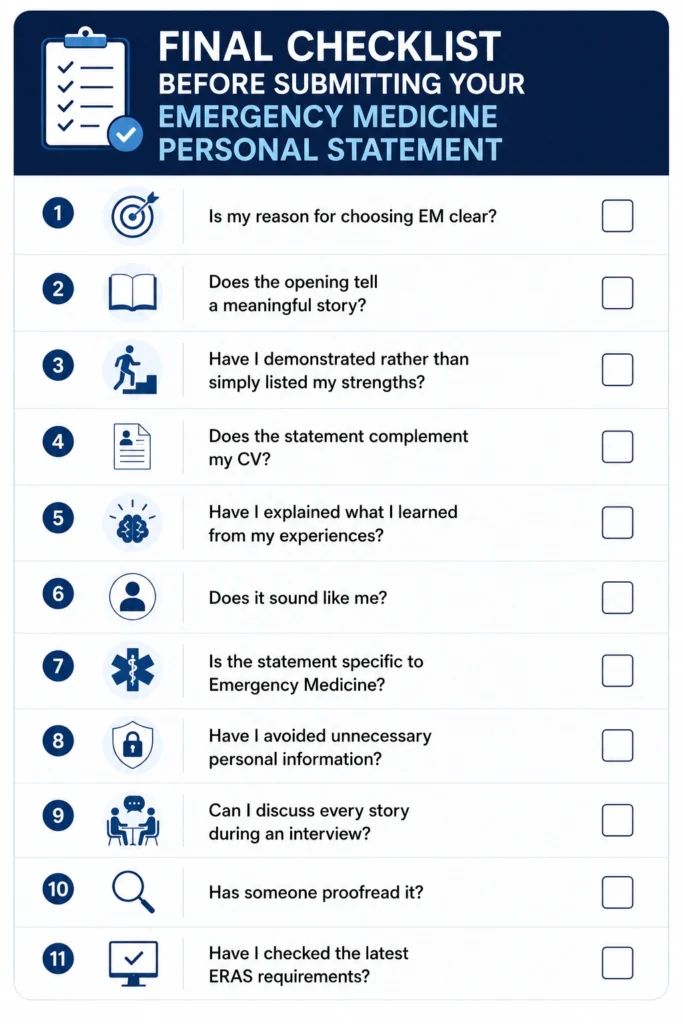
Start with a clinical experience that genuinely influenced your decision. Explain what you learned and connect it to what EM actually involves, like undifferentiated patients, acute decisions, and constant team work. Add two or three experiences that prepared you, then close with where you’re headed. Show your qualities through examples rather than claiming them outright.
Your motivation, relevant clinical and non clinical experiences, EM specific qualities demonstrated in real situations, what you’ll contribute to a program, and your career goals. All of it tied to one clear line of thinking.
For structure and brainstorming, yes. Reading a few helps you see how an opening builds and how a conclusion lands. Copying language is a different matter. Plagiarism detection is part of the process, and a copied statement can end an application permanently.
Usually 600 to 850 words, about one page. Check the current ERAS character limit before you submit, since requirements shift between cycles.
Mention it when it adds something your experience entries can’t, like what you learned about American ED workflow or how your approach changed. For how to list it properly elsewhere in the file, see US clinical experience for your ERAS CV. Skip it in the statement if you’re only listing rotation names and dates.
The core statement stays the same across programs. Add program specific content only when it’s true and relevant, such as a real regional tie or a genuine connection to a fellowship strength. Generic flattery is transparent and doesn’t earn anything, especially now that program signals carry that message more efficiently.
They usually do. Assume every sentence is open. Know the details of any case you describe, including your actual role and what happened to the patient.
A strong EM personal statement isn’t an achievement list and it isn’t a persuasion exercise. It’s one clear account of how you got to this specialty, built from experiences only you had, written in language a tired program director can follow at the end of a long review day.
Start early. Write badly on the first pass. Cut hard on the second. Ask someone who knows Emergency Medicine to read it before you submit. And make sure the person on the page sounds like the person who shows up on interview day, because that gap is noticeable and it costs applicants more than they realize.
The strongest statements aren’t the most dramatic, they’re the most honest and the most clearly reasoned. That’s hard to see in your own writing, which is where we come in. Here’s what we do:
Articles published by IMG Helping Hands are prepared by our team using information from direct experience, publicly available resources, and educational references. AI tools may be used to assist with drafting, proofreading, and formatting; however, all content undergoes review and approval before publication.
The information provided is intended for educational purposes only. Requirements, policies, and processes may change over time. Readers should consult official sources for the most current information.