

| Spirochetes are thin, spiral shaped bacteria that move using internal axial filaments called endoflagella. The three genera tested on Step 1 are Treponema (syphilis), Borrelia (Lyme disease and relapsing fever), and Leptospira (leptospirosis and Weil disease). They are separated by vector and hallmark: Treponema is sexually transmitted and needs darkfield microscopy, Borrelia is carried by the Ixodes tick and causes the erythema migrans rash, and Leptospira is caught from water contaminated with animal urine. |
Spirochetes look intimidating, but for USMLE Step 1 they are one of the most predictable and high yield topics in microbiology. The spirochete diseases you must know are syphilis, Lyme disease, relapsing fever, and leptospirosis. Master three genera, a framework for syphilis and Lyme, and one serology algorithm, and your correct MCQs will speak for themselves. This algorithm driven approach is exactly how IMG Helping Hands trains International Medical Graduates inside the USMLE Impact Theory (UIT) course to lock in spirochetes fast, and this blog gives you the same system. Every claim below is aligned with the current USMLE Step 1 content outline and standard references, which are listed at the end [4][11].
Spirochetes are long, thin, spiral (helical) bacteria. Their defining feature is motility driven by axial filaments, also called endoflagella, which run in the periplasmic space between the inner and outer membranes and spin the cell forward like a corkscrew. This is why live spirochetes look like drilling coils under the microscope. They have a double membrane like Gram negative bacteria but stain poorly, so a Gram stain is not useful If that distinction is shaky, review Gram-positive vs Gram-negative bacteria [6].
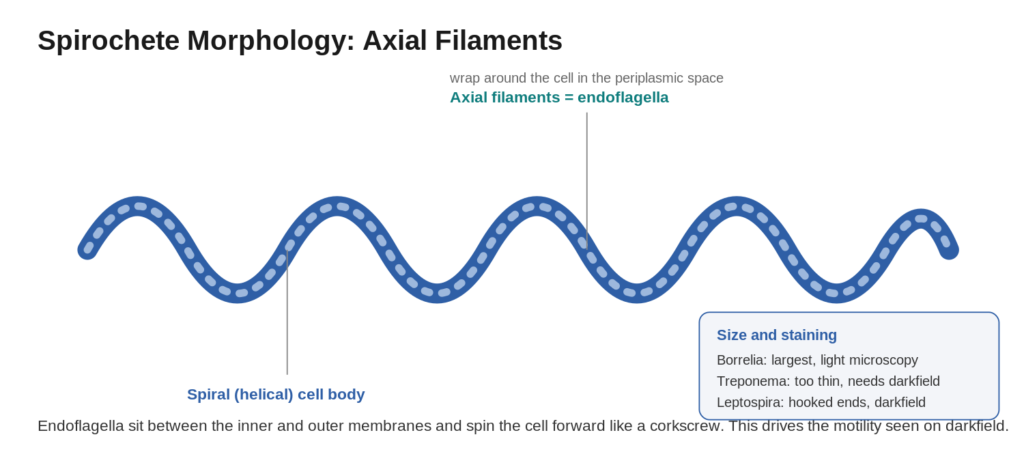
There are three genera you must know: Treponema, Borrelia, and Leptospira. They differ in size and how you visualize them. Borrelia is the largest and is visible on light microscopy with Giemsa or Wright stain. Treponema pallidum is too thin to see on routine light microscopy, so it is visualized by darkfield microscopy or direct fluorescent antibody. Leptospira has distinctive hooked ends and a question mark shape.
Treponema pallidum cannot be grown on standard artificial laboratory media, so you cannot culture it the way you culture most bacteria [9]. Diagnosis therefore relies on darkfield microscopy of fresh lesion fluid and on serology, not on culture. This is a favorite exam point.
| MNEMONIC: The three genera, BLT: Borrelia, Leptospira, Treponema. Size and staining hook: Borrelia is Big (largest, seen on light microscopy), Treponema is Tiny (needs darkfield), and Leptospira has a question mark shape with hooked ends. |
| HIGH YIELD: Spirochete shape plus axial filament motility is the core concept. If a question describes a thin, motile, corkscrew organism on darkfield from a genital ulcer, it is Treponema pallidum, because it cannot be cultured and is too thin for light microscopy. |
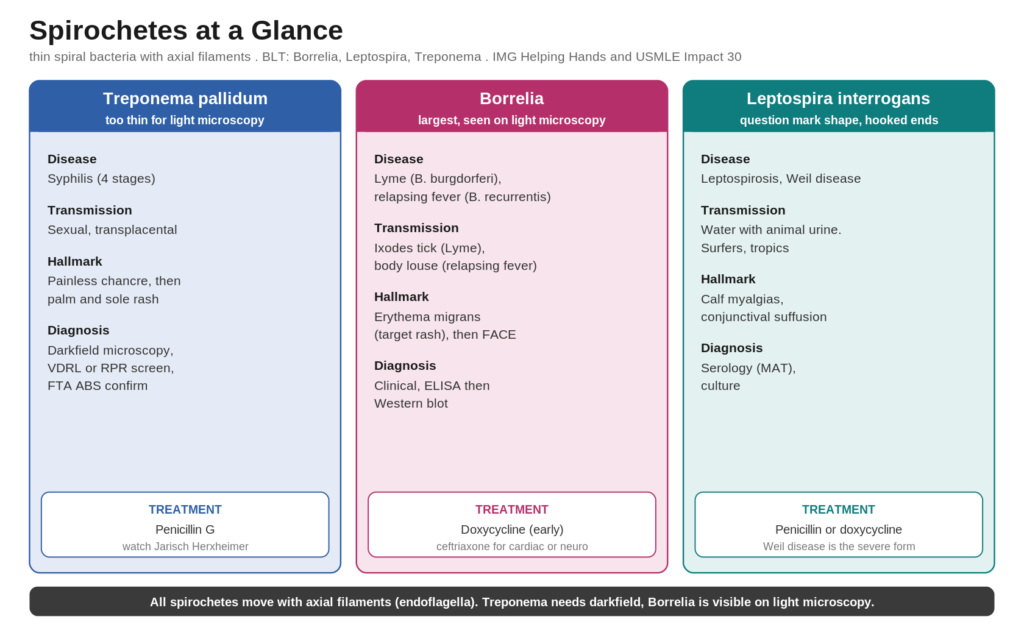
One row per organism, built for fast recall and for direct citation. Use it as your spirochetes chart.
| Genus and species | Disease | Vector or transmission | Hallmark presentation | Diagnosis | Treatment |
|---|---|---|---|---|---|
| Treponema pallidum | Syphilis | Sexual contact, transplacental | Painless chancre, then palm and sole rash | Darkfield, VDRL or RPR, FTA ABS | Penicillin G |
| Borrelia burgdorferi | Lyme disease | Ixodes tick | Erythema migrans (target rash) | Clinical, ELISA then Western blot | Doxycycline, ceftriaxone if cardiac or neuro |
| Borrelia recurrentis | Relapsing fever | Body louse | Recurrent fevers from antigenic variation | Blood smear (visible spirochetes) | Doxycycline or tetracycline |
| Leptospira interrogans | Leptospirosis and Weil disease | Water with animal urine | Calf myalgias, conjunctival suffusion | Serology (MAT), culture | Penicillin or doxycycline |
That’s the UIT method. Learn every high-yield Step 1 microbiology topic as an algorithm, not a list to memorize.
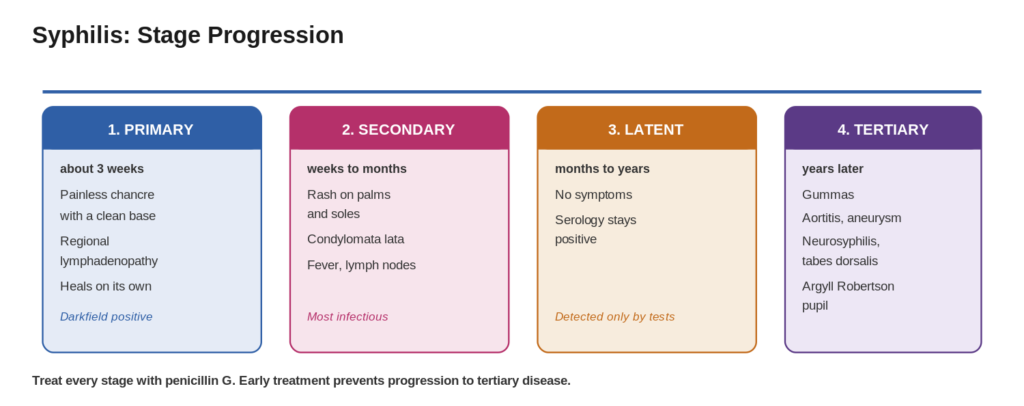
Syphilis is the big one. It progresses through four stages, each with signature findings, and it is tested through both clinical vignettes and serology interpretation.
| Stage | Timing | Key findings | Note |
|---|---|---|---|
| Primary | About 3 weeks | Painless, indurated chancre with a clean base, regional lymphadenopathy. Heals on its own | Darkfield positive |
| Secondary | Weeks to months | Diffuse maculopapular rash including the palms and soles, condylomata lata (broad wart like lesions), fever, lymphadenopathy, mucous patches, patchy alopecia | Most infectious stage |
| Latent | Months to years | No symptoms, positive serology only | Early and late latent |
| Tertiary | Years later | Gummas, cardiovascular syphilis (aortitis and ascending aortic aneurysm), neurosyphilis (tabes dorsalis, general paresis), Argyll Robertson pupil | Vasa vasorum endarteritis |
| MNEMONIC: Syphilis stages in order: Primary is a Painless chancre, Secondary is Systemic (rash on palms and Soles plus condylomata lata), Latent is Silent, and Tertiary is Terrible (gummas, aorta, and neurosyphilis). One to two to three, painless to systemic to terrible. |
| TRAP: The classic trap is painless versus painful genital ulcer. Syphilis gives a PAINLESS chance. A PAINFUL genital ulcer points to chancroid from Haemophilus ducreyi instead. Do not mix these up. |
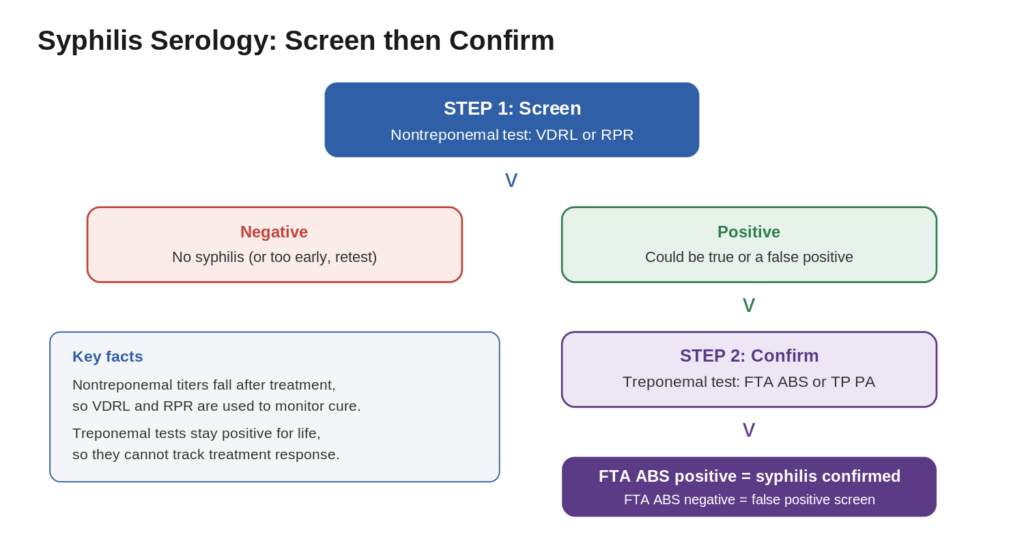
Because Treponema cannot be cultured, diagnosis uses darkfield microscopy of early lesions plus a two step serology algorithm. In the traditional algorithm you screen with a nontreponemal test and confirm with a treponemal test [1].
| Feature | Nontreponemal (VDRL or RPR) | Treponemal (FTA ABS or TP PA) |
|---|---|---|
| Role | Screening test | Confirmatory test |
| What it detects | Antibodies against cardiolipin | Antibodies against treponemal antigens |
| Specificity | Lower, false positives occur | High, very specific |
| After treatment | Titers fall, so it monitors cure | Stays positive for life |
| Best use | Screen and follow response | Confirm a positive screen |
| CURRENCY NOTE: Many modern laboratories now use a reverse sequence algorithm that runs an automated treponemal immunoassay first and then a nontreponemal test to confirm and quantify [1]. For Step 1, learn the traditional screen then confirm the sequence shown above, but recognize the reverse algorithm if a question mentions it. A fourfold drop in nontreponemal titer indicates successful treatment. |
| MNEMONIC: VDRL false positives, expand VDRL: Viral infections (mononucleosis, hepatitis, HIV), Drugs and IV drug use, Rheumatic fever and Rheumatoid arthritis, and Lupus and Leprosy. Pregnancy can also cause a false positive. |
| HIGH YIELD: A positive VDRL or RPR with a negative FTA ABS is a biologic false positive, not syphilis. The treponemal test is what confirms true infection. Reverse this and you will miss easy points. |
| TRAP: Use the right test for the right job. Nontreponemal titers (VDRL and RPR) fall after successful treatment, so they track cure. Treponemal tests (FTA ABS) stay positive for life, so they cannot tell you whether treatment worked. |
Tertiary syphilis appears years later and is high yield. Gummas are soft granulomas in skin and bone. Cardiovascular syphilis is aortitis of the ascending aorta caused by endarteritis of the vasa vasorum, which weakens the wall and produces a thoracic aortic aneurysm and a tree bark appearance. Neurosyphilis includes tabes dorsalis (degeneration of the dorsal columns causing ataxia, a positive Romberg sign, and loss of proprioception and vibration) and general paresis. The Argyll Robertson pupil constricts with accommodation but does not react to light.
| MNEMONIC: Argyll Robertson pupil accommodates but does not react. It narrows when focusing on a near object but does not constrict to light. Classic for neurosyphilis, and often called the pupil that accommodates but does not react. |
Congenital syphilis follows transplacental spread and shows snuffles, a saddle nose, notched Hutchinson teeth, mulberry molars, and saber shins. It is prevented by screening and treating the mother with penicillin. For how it sits alongside the other congenital bugs, see our guide to TORCH infections for USMLE Step 1.
The Jarisch Herxheimer reaction is a flu-like reaction with fever, chills, and myalgias that begins within hours of starting penicillin, caused by a burst of cytokines as spirochetes are killed. It is self limited and is not a penicillin allergy.
| HIGH YIELD: Jarisch Herxheimer reaction: fever, chills, and muscle aches within hours of the first penicillin dose for a spirochete infection. Reassure and support the patient. Do not stop penicillin and do not call it an allergy. |
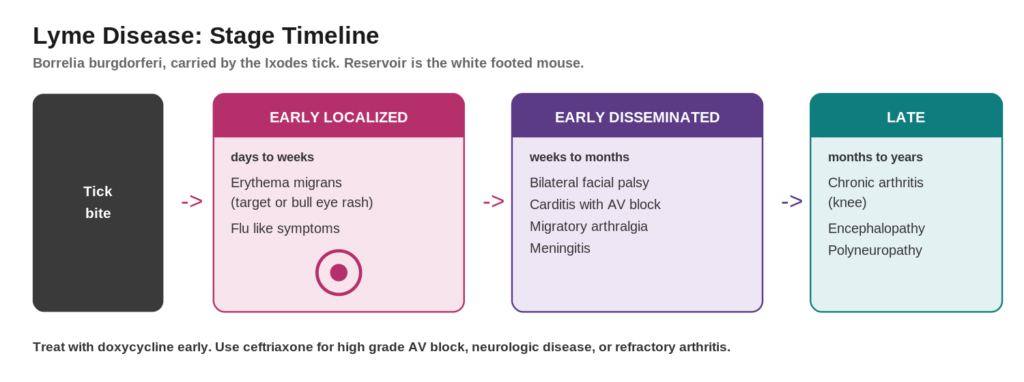
Lyme disease is caused by Borrelia burgdorferi, transmitted by the Ixodes tick [2]. The reservoir is the white footed mouse, and deer are needed to complete the tick life cycle. It is a classic tick borne illness of the northeastern United States and progresses through three stages.
| Stage | Timing | Key findings | Treatment |
|---|---|---|---|
| Early localized | Days to weeks | Erythema migrans, an expanding target or bull eye rash, with flu like symptoms | Doxycycline |
| Early disseminated | Weeks to months | Multiple erythema migrans, bilateral facial (Bell) palsy, carditis with AV block, migratory arthralgia, meningitis | Doxycycline, ceftriaxone if cardiac or neuro |
| Late | Months to years | Chronic monoarticular arthritis (knee), encephalopathy, polyneuropathy | Doxycycline or ceftriaxone |
| MNEMONIC: Lyme hits your FACE: Facial nerve palsy (often bilateral), Arthritis (migratory then chronic), Cardiac block (AV block), and Erythema migrans. The target rash comes first, then FACE. |
| CURRENCY NOTE: The 2020 IDSA, AAN, and ACR Lyme disease guidelines make doxycycline the preferred first line drug for most early Lyme disease, usually for 10 to 14 days, and short courses of doxycycline are now considered safe in children of any age [3]. Intravenous ceftriaxone is reserved for severe carditis such as high grade AV block, for meningitis, and for other serious neurologic disease. Erythema migrans alone is enough to treat without waiting for serology [2]. |
| TRAP: Bilateral facial nerve palsy is a strong Lyme clue. Unilateral Bell palsy is usually idiopathic, but bilateral facial palsy should make you think of Lyme disease (and a few other systemic causes). |
Relapsing fever is caused by Borrelia recurrentis and is spread by the body louse. The organism undergoes antigenic variation, changing its surface proteins so the immune system must respond again and again. This produces recurring febrile episodes that relapse and remit. Because Borrelia is large, the spirochetes can actually be seen on a peripheral blood smear during fever. Treat with doxycycline or tetracycline, and watch for a Jarisch Herxheimer reaction.
| MNEMONIC: Relapsing fever relapses because of antigenic variation. Each time the body clears one surface antigen, Borrelia switches to a new one and the fever returns. Louse borne means Borrelia recurrentis. |
Leptospirosis is caught from water contaminated with animal urine, classically in surfers, triathletes, farmers, and travelers to tropical areas such as Hawaii [8][10]. The organism has a question mark shape with hooked ends. Typical illness is flu like with high fever, severe calf and muscle myalgias, headache, photophobia, and conjunctival suffusion, which is redness of the conjunctiva without pus. The course can be biphasic.
Weil disease is the severe icteric form. It features jaundice, azotemia from acute kidney injury, and hemorrhage, and can include pulmonary hemorrhage. Diagnose with serology (the microscopic agglutination test) or culture, and treat with penicillin or doxycycline [8]. Doxycycline is also used for prophylaxis.
| MNEMONIC: Weil disease, the severe three: Jaundice (liver), azotemia (kidney), and hemorrhage (bleeding). Add the exposure clue of a surfer or floodwater and the conjunctival suffusion, and Leptospira is the answer. |
| HIGH YIELD: Conjunctival suffusion plus severe calf myalgias plus a water or animal urine exposure is the classic Leptospira picture. When jaundice, kidney failure, and bleeding are added, that is Weil disease, the severe form. |
Spirochetes are tested alongside other tick borne infections, so keep the vectors straight.
| Illness | Organism and vector | Buzzword |
|---|---|---|
| Lyme disease | Borrelia burgdorferi, Ixodes tick | Erythema migrans, FACE |
| Babesiosis | Babesia, Ixodes tick | Maltese cross, hemolytic anemia |
| Anaplasmosis | Anaplasma, Ixodes tick | Morulae in granulocytes |
| Rocky Mountain spotted fever | Rickettsia rickettsii, Dermacentor tick | Rash on wrists and ankles, then palms and soles |
| Tick borne relapsing fever | Borrelia hermsii, soft tick | Recurrent fevers |
| TRAP: The Ixodes tick transmits Lyme, Babesia, and Anaplasma, so coinfection is possible. Rocky Mountain spotted fever is a different vector (Dermacentor) and is not a spirochete. |
| Buzzword or clue | Diagnosis |
|---|---|
| Painless genital ulcer with a clean base | Primary syphilis (chancre) |
| Rash on the palms and soles, condylomata lata | Secondary syphilis |
| Argyll Robertson pupil, tabes dorsalis | Tertiary neurosyphilis |
| Ascending aortic aneurysm, tree bark aorta | Cardiovascular tertiary syphilis |
| Positive VDRL, negative FTA ABS | Biologic false positive, not syphilis |
| Fever and myalgias hours after penicillin | Jarisch Herxheimer reaction |
| Target or bull eye rash after a hike | Erythema migrans of Lyme disease |
| Bilateral facial palsy, AV block | Early disseminated Lyme disease |
| Recurrent fevers, body louse, antigenic variation | Relapsing fever (Borrelia recurrentis) |
| Surfer, calf myalgias, conjunctival suffusion | Leptospirosis |
| Jaundice, kidney failure, and hemorrhage | Weil disease (severe leptospirosis) |
Spirochetes are thin, spiral shaped bacteria that move using internal axial filaments called endoflagella. The three that matter for USMLE are Treponema (syphilis), Borrelia (Lyme disease and relapsing fever), and Leptospira (leptospirosis).
Treponema pallidum, Borrelia species (burgdorferi and recurrentis), and Leptospira interrogans. Remember them with BLT: Borrelia, Leptospira, Treponema.
Treponema pallidum does not grow on standard artificial laboratory media, so it cannot be cultured. Diagnosis instead uses darkfield microscopy of lesion fluid and serology such as VDRL or RPR and FTA ABS.
VDRL and RPR are nontreponemal screening tests whose titers fall after treatment, so they monitor cure but can give false positives. FTA ABS is a treponemal confirmatory test that is highly specific and stays positive for life.
Early Lyme disease is treated with oral doxycycline, usually for 10 to 14 days. Intravenous ceftriaxone is used for severe carditis such as high grade AV block, for meningitis, and for other serious neurologic disease. Erythema migrans alone is enough to start treatment.
See the highest-yield Step 1 systems mapped the same algorithm-driven way, free, and built for IMGs.
Original questions written in Step 1 clinical vignette format. Answers and explanations follow.
A 25 year old man has a single, firm, painless genital ulcer with a clean base and rubbery regional lymph nodes. Fluid from the lesion under darkfield microscopy shows thin, motile, corkscrew organisms. Which organism is most likely?
A. Haemophilus ducreyi
B. Treponema pallidum
C. Herpes simplex virus
D. Klebsiella granulomatis
E. Chlamydia trachomatis
A 30 year old woman with systemic lupus erythematosus has a positive RPR during routine screening. A confirmatory FTA ABS is negative. What is the best interpretation?
A. Active primary syphilis
B. Latent syphilis
C. A biologic false positive result
D. Tertiary syphilis
E. Successfully treated syphilis
A 28 year old man has a diffuse maculopapular rash that involves the palms and soles, along with broad, moist, wart like lesions in the perineum and generalized lymphadenopathy. Which stage of syphilis is this?
A. Primary
B. Secondary
C. Early latent
D. Tertiary
E. Congenital
A 40 year old hiker in Connecticut develops an expanding red rash with central clearing, giving a target appearance, two weeks after a tick bite, along with fatigue and low grade fever. What is the best initial treatment?
A. Penicillin G
B. Doxycycline
C. Ceftriaxone
D. Azithromycin
E. Acyclovir
A 35 year old man has palpitations and syncope. ECG shows third degree AV block, and he also has bilateral facial droop. He recalls a target shaped rash weeks earlier after camping. What is the most appropriate treatment?
A. Oral doxycycline at home
B. Intravenous ceftriaxone
C. Oral amoxicillin
D. Permanent pacemaker only
E. Penicillin G benzathine
A 24 year old surfer in Hawaii develops high fever, severe calf muscle pain, red eyes without discharge, and then jaundice with rising creatinine and mucosal bleeding. Which organism is responsible?
A. Leptospira interrogans
B. Borrelia burgdorferi
C. Treponema pallidum
D. Rickettsia rickettsii
E. Borrelia recurrentis
A 32 year old woman is treated with penicillin for early syphilis. Six hours later she develops fever, chills, headache, and muscle aches that resolve within a day. What is the most likely cause?
A. Penicillin anaphylaxis
B. Jarisch Herxheimer reaction
C. Progression to secondary syphilis
D. Serum sickness
E. A new viral infection
A 55 year old man has gait unsteadiness that worsens in the dark, loss of vibration and position sense, and pupils that constrict when focusing on a near object but do not react to light. Which condition explains these findings?
A. Multiple sclerosis
B. Tertiary neurosyphilis
C. Vitamin B12 deficiency
D. Diabetic neuropathy
E. Guillain Barre syndrome
A traveler living in crowded conditions with body lice has repeated episodes of high fever, each lasting a few days, separated by afebrile intervals. Blood smear during fever shows large spirochetes. What best explains the recurring fevers?
A. Reinfection with a new organism each time
B. Antigenic variation of surface proteins
C. Formation of a latent reservoir in neurons
D. Slow replication of the organism
E. Immune tolerance to the organism
A 60 year old man is found to have an incidental thoracic aortic aneurysm of the ascending aorta. Pathology of the aortic wall shows endarteritis of the vasa vasorum. This is a late complication of which infection?
A. Lyme disease
B. Leptospirosis
C. Syphilis
D. Relapsing fever
E. Chancroid
1. Correct answer B. A painless, indurated genital ulcer with motile corkscrew organisms on darkfield is a primary syphilis chancre from Treponema pallidum. Haemophilus ducreyi causes a painful ulcer, HSV causes painful vesicles and ulcers, Klebsiella granulomatis causes painless beefy granulomatous ulcers with Donovan bodies, and Chlamydia causes lymphogranuloma venereum.
2. Correct answer C. A positive nontreponemal test (RPR) with a negative treponemal test (FTA ABS) is a biologic false positive, classically seen in lupus and the antiphospholipid syndrome. It is not true syphilis, so the other options are wrong.
3. Correct answer B. A rash on the palms and soles with condylomata lata and generalized lymphadenopathy is secondary syphilis, the most infectious stage. A chancre is primary, latent has no findings, tertiary shows gummas and neurosyphilis, and congenital is in newborns.
4. Correct answer B. Erythema migrans after a tick bite is early Lyme disease, treated with oral doxycycline. Ceftriaxone is reserved for severe cardiac or neurologic Lyme, and the other agents are not first line for early Lyme.
5. Correct answer B. High grade AV block with bilateral facial palsy after a target rash is early disseminated Lyme carditis and neuroborreliosis, which is treated with intravenous ceftriaxone. Oral agents are not adequate for high grade block, and a pacemaker alone does not treat the infection.
6. Correct answer A. A water exposed surfer with calf myalgias, conjunctival suffusion, jaundice, kidney injury, and bleeding has Weil disease from Leptospira interrogans. The other organisms do not fit the water exposure and the jaundice with renal failure.
7. Correct answer B. Fever, chills, and myalgias within hours of penicillin for a spirochete infection is the Jarisch Herxheimer reaction, caused by cytokine release from killed organisms. It is self limited and is not anaphylaxis or an allergy.
8. Correct answer B. Sensory ataxia worse in the dark, loss of vibration and proprioception (tabes dorsalis), and an Argyll Robertson pupil that accommodates but does not react are tertiary neurosyphilis. B12 deficiency lacks the pupil finding, and the other options do not fit the pupil and dorsal column pattern.
9. Correct answer B. Relapsing fever from Borrelia recurrentis recurs because the organism changes its surface antigens through antigenic variation, so the immune system must respond repeatedly. It is not reinfection or a neuronal reservoir.
10. Correct answer C. Ascending aortic aneurysm with endarteritis of the vasa vasorum is cardiovascular tertiary syphilis. Lyme, leptospirosis, relapsing fever, and chancroid do not cause this vasa vasorum aortitis.
Get an honest read on your Step 1 prep from IMG mentors who’ve matched, and a plan built around your weak areas.
Spirochetes become easy once you hold three anchors. Know the three genera with BLT and how each is seen. Stage syphilis from a painless chancre to a palm and sole rash to tertiary gummas, aortitis, and neurosyphilis, and run the serology algorithm from VDRL to FTA ABS. Stage Lyme from erythema migrans to FACE to late arthritis. Then place Leptospira with its water exposure, calf myalgias, conjunctival suffusion, and Weil disease. Layer the vector or exposure clue on top and the vignette solves itself.
This staged, algorithm driven method is exactly how IMG Helping Hands trains International Medical Graduates inside the USMLE Impact 30 (UIT) course, turning spirochetes into one of the fastest scoring topics on the exam. If this guide made the pieces click, that is the experience USMLE Impact 30 delivers across every high yield Step 1 topic.
Related reading: bacterial exotoxins guide, and the TORCH infections guide.
| Editorial policy: This guide is written for education and is aligned with the current USMLE Step 1 content outline and the standard references listed below. It is reviewed by a licensed physician and updated as guidelines change. It is not a substitute for clinical judgment or primary references. |
1. Centers for Disease Control and Prevention. Sexually Transmitted Infections Treatment Guidelines, 2021. MMWR Recommendations and Reports, volume 70, number 4. Available at cdc.gov/std/treatment-guidelines.
2. Centers for Disease Control and Prevention. Lyme Disease, Clinical Overview and Signs and Symptoms. Available at cdc.gov/lyme.
3. Lantos PM, Rumbaugh J, Bockenstedt LK, and colleagues. Clinical Practice Guidelines by the Infectious Diseases Society of America, the American Academy of Neurology, and the American College of Rheumatology, 2020 Guidelines for the Prevention, Diagnosis, and Treatment of Lyme Disease. Clinical Infectious Diseases, 2021, volume 72, issue 1.
4. Le T and Bhushan V. First Aid for the USMLE Step 1. McGraw Hill, current edition.
5. Levinson W. Review of Medical Microbiology and Immunology. McGraw Hill, current edition.
6. Murray PR, Rosenthal KS, and Pfaller MA. Medical Microbiology. Elsevier, current edition.
7. Ryan KJ, editor. Sherris and Ryan Medical Microbiology. McGraw Hill, current edition.
8. Haake DA and Levett PN. Leptospirosis in Humans. Current Topics in Microbiology and Immunology, 2015, volume 387.
9. Radolf JD, Deka RK, Anand A, and colleagues. Treponema pallidum, the Stealth Pathogen. Nature Reviews Microbiology, 2016, volume 14.
10. World Health Organization. Leptospirosis, Fact Sheets and Technical Guidance. Available at who.int.
11. United States Medical Licensing Examination. Step 1 Content Outline and Specifications. Available at usmle.org.
IMG HELPING HANDS – UIT USMLE STEP 1 PROGRAM
Stage syphilis. Run VDRL to FTA-ABS. Track Lyme through erythema migrans to FACE. Anchor Leptospira to water, calf myalgias, and conjunctival suffusion. That’s the entire UIT method, concept first, algorithm second, buzzword last, wired together so it holds under exam pressure.
The same logic runs through every high-yield system on Step 1. UIT crash courses teach microbiology, pharmacology, pathology, and physiology this way, live, mapped to First Aid, and built specifically for IMGs.
Algorithm-driven teaching. Mnemonic-based recall. FA-mapped structure. Live IMG mentorship from doctors who’ve matched.
Learn the algorithm once. Solve every vignette.
Articles published by IMG Helping Hands are prepared by our team using information from direct experience, publicly available resources, and educational references. AI tools may be used to assist with drafting, proofreading, and formatting; however, all content undergoes review and approval before publication.
The information provided is intended for educational purposes only. Requirements, policies, and processes may change over time. Readers should consult official sources for the most current information.